

What Size Rug Do I Need?
The right size is whichever one actually anchors your furniture instead of drifting around under it. The rule worth memorizing: go big enough that at least the front legs of every major seating piece sit on the rug, and leave about 18 inches of bare floor between the rug’s edge and the wall. Most rooms land on a familiar size anyway, a 5×8 for something tight, an 8×10 for a standard living room, a 9×12 when you want a bit of generosity.
One thing first, because it’s the thing nearly everyone gets wrong: the too-small rug. It’s far and away the most common mistake, and instead of grounding a room it shrinks it. So when you’re stuck between two sizes? Size up. Every time.
What Is the General Rule With Area Rug Size?
Simple enough: a rug should pull a seating area together, not slice it apart. That means it has to run wide enough to tuck under the curated furniture framing the room. A rug that only reaches the coffee table, leaving the sofa and chairs marooned on bare floor, reads as an afterthought. You feel it the second you walk in.
There are two schools of thought on how far to take it. All-legs-on puts every leg fully on the rug, which feels grand in a bigger living room. Front-legs-on is the looser, more forgiving option, and it’s the one most people end up reaching for. As the design team at Castlery puts it, Position the rug to extend just under the front legs of your sofa and chairs. Both work fine. The only real loser is the rug floating in the middle, touching nothing at all.
What Rug Size Do You Need for Your Living Room?
For most living rooms it’s an 8×10 or a 9×12, full stop. An 8×10 catches the front legs of a standard sofa plus a couple of chairs. A 9×12 lets you park every leg on the rug for that pulled-together look, and it does nice work in open-plan spaces that need a defined edge.
Working with something smaller? A 6×9 can hold its own, especially with a loveseat and one chair. Here’s a trick worth the five minutes before you spend a dime: tape out the rug on the floor with painter’s tape and live with it for a day. You’ll know fast if the furniture’s hanging off the edges. And if you’d rather size it up in person, a furniture showroom laid out in full room vignettes is the place to do it. One more thing, mind the wall gap. About 18 inches of bare floor keeps the whole thing from reading wall-to-wall.
What Size Rug Goes Under a Bed?
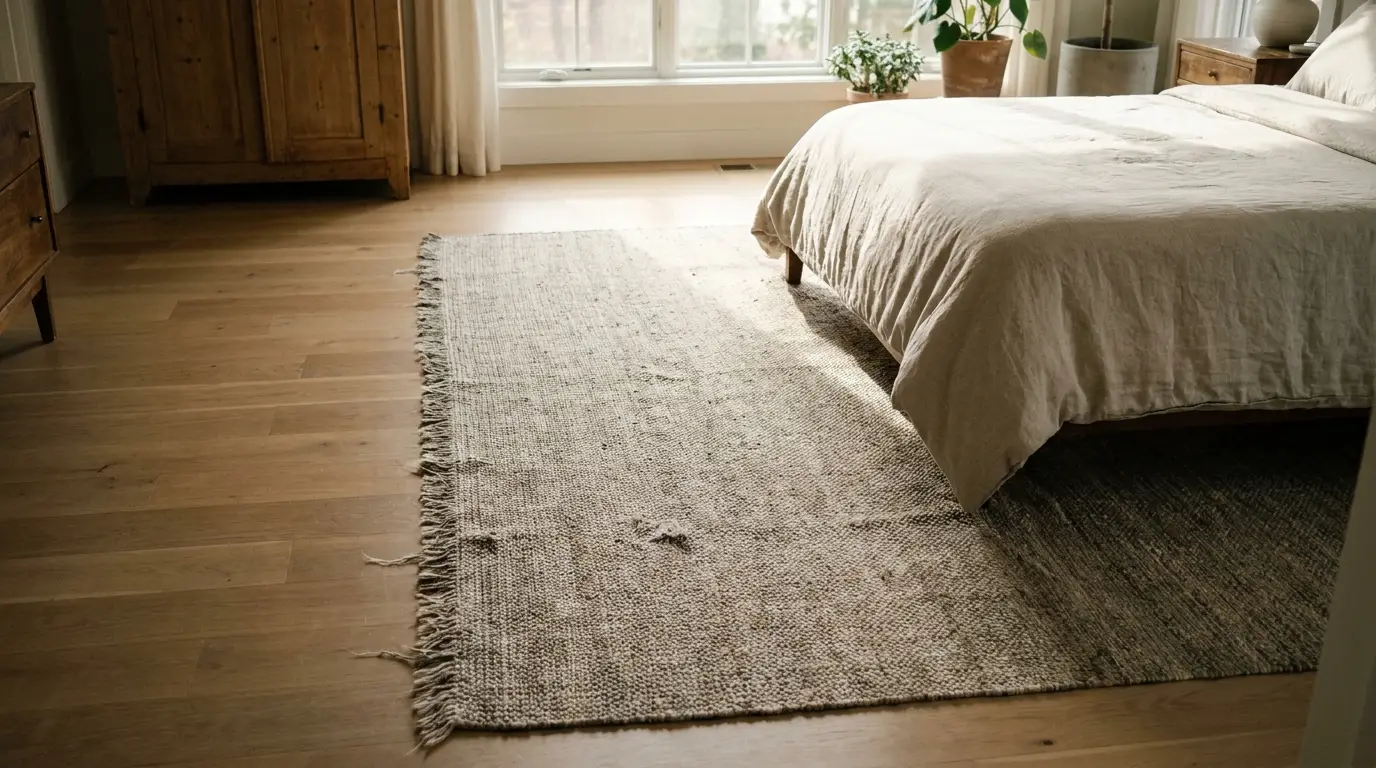
Under a bed, you want the rug running well past the mattress so your feet hit something soft in the morning. Cleanest look: slide it under the lower two-thirds of the bed, past the foot and out beyond both sides, with the nightstands left off on bare floor.
How far past the sides, though? Houzz gives a clean benchmark: it should be large enough to extend beyond the sides of the bed at least 18 inches for a king or queen bed and at least 12 inches for a full or twin bed. In practice that’s a 9×12 under a king, an 8×10 under a queen, a 5×8 or 6×9 under a full or twin. Not into running a rug under the bed at all? A runner down each side is a tidy way out.
What Size Rug Do You Need for a Dining Room?
A dining room rug has one job that beats all the others: every chair stays on the rug even when it’s pulled out. So the thing needs to reach a good margin past the table on all four sides.
The number designers keep coming back to is 24 inches. As Houzz notes, It is much easier to maneuver dining chairs if there is at least 24 inches of rug extending from the edge of the table on all sides. Measure the table, tack on 24 inches per side, and shop to that. A six-seater usually wants an 8×10. Seat eight and you’re happier on a 9×12.
How Do You Measure a Room for a Rug?
Start with the furniture, not the floor. Set the seating the way you actually plan to live with it, then measure that grouping edge to edge. Add the room you need for the rug to slide under the front legs and there’s your minimum. Then knock about 18 inches off each wall so the rug doesn’t crowd the room.
One honest heads-up before you buy. An 8×10 really is about 8 feet by 10, but woven and hand-knotted rugs wander an inch or two, and fringe usually gets measured on its own. When it’s a close call, go bigger. Browse the rug collection by size, and if a second set of eyes would help, that’s exactly what an interior design studio is for.
Frequently Asked Questions
Is an 8×10 Rug Actually 8×10?
Close, but almost never down to the exact inch. It runs about 8 feet by 10, though handmade and woven rugs drift an inch or two either way, over or under whatever the label claims. Fringe and binding usually get measured on their own.
Is a 9×12 Rug Too Big for a Living Room?
Usually no. It’s the default for standard and bigger living rooms precisely because it lets every furniture leg sit on the rug. The only time it tips into too-big is when there’s less than about 18 inches of bare floor left between the rug and the walls.
What Size Rug Should I Get for a 12×12 Room?
An 8×10 is the safe bet for a 12-by-12. It anchors the seating group and still leaves roughly 18 inches of floor showing on each side, so nothing crowds the walls. Working with compact furniture? A 6×9 can carry it too.
Is It Better to Have a Rug That’s Too Big or Too Small?
Too big, nearly every time. A slightly oversized rug grounds the furniture and makes the whole room feel larger and more deliberate. Too small does the reverse and shrinks everything. Stuck between two? Size up.


