12 Types of Wood Joints Every Woodworker Should Know
A woodworking project can look solid from the outside but still fail because of the wrong joint choice. The way two wooden pieces connect often decides how long the structure will last and how well it handles pressure over time.
Some wooden joints are built for heavy support, while others are better for clean corners or quick assembly. Each type works differently based on the project and the amount of pressure it needs to handle.
Understanding the differences between wooden joints helps woodworkers choose the right joinery method for furniture, cabinets, shelves, and other woodworking projects.
Understanding the Basics of Wood Joinery
Wooden joints are connections used to join two or more pieces of wood into a stable structure. They are commonly used in furniture, cabinets, frames, doors, and other woodworking projects.
The purpose of wood joinery is to improve strength, support, and alignment between wooden parts. Different joints are designed for different applications and load requirements.
Wood joints are often stronger and more durable than using nails alone. Many joinery methods also create cleaner connections with fewer visible fasteners.
How Wooden Joints Differ From Each Other

Wooden joints are designed for different woodworking purposes based on strength, appearance, flexibility, and construction style. Some joints are built for heavy support, while others are mainly used for decorative detail, cleaner finishes, or faster assembly.
- Strength and Load Capacity – Different joints can handle different amounts of weight and pressure. Strong joints like mortise and tenon or dovetail joints are commonly used in furniture and structural woodworking.
- Appearance and Finish – Some joints stay hidden inside the structure, while others remain visible as part of the design. Decorative joints are often used in cabinets, drawers, and trim work.
- Difficulty Level and Tools Required – Basic joints can be created with simple woodworking tools and beginner skills. Advanced joints usually require precise cutting, accurate measurements, and specialized equipment.
- Indoor and Outdoor Applications – Certain joints are better suited for indoor furniture and cabinets, while others perform better in outdoor projects exposed to moisture and weather changes.
- Permanent vs Temporary Joinery – Permanent joints are designed for long-term durability and are usually glued or tightly fitted. Temporary joints can be removed more easily for repairs or adjustments.
Understanding these differences is what separates functional joinery from truly skilled woodworking. The more clearly you can read a project’s demands, the more confidently you can choose the joint that meets them.
Common Types of Wood Joints Used in Woodworking
Different woodworking projects require different types of wooden joints based on strength, appearance, durability, and construction style. Each joint is designed for specific applications in furniture, cabinets, frames, flooring, and other woodworking projects.
Some joints are better for heavy structural support, while others are mainly used for decorative detail, hidden connections, or faster assembly. Understanding these joint types helps in selecting the right joinery method for each woodworking project.
1. Butt Joint

A butt joint is one of the simplest wooden joints where two wood pieces are connected end to end or edge to edge. It is commonly secured using nails, screws, or wood glue for added support.
This joint is widely used in basic woodworking projects, simple frames, and temporary structures. Although easy to create, butt joints are generally weaker than advanced joinery methods unless reinforced properly.
Application: Used for simple woodworking projects where two pieces of wood are joined end to end or edge to edge. Common in basic frames, temporary structures, and beginner DIY projects because it is quick and easy to make.
2. Miter Joint

A miter joint connects two wooden pieces at an angled edge, usually at 45 degrees, to form a clean corner. It is commonly used where appearance is important in woodworking projects.
Miter joints are often found in picture frames, trim work, and decorative molding. Unlike butt joints, they create smoother corners with less visible end grain.
Application: Used for projects that need clean and neat corner connections with hidden wood edges. Common in picture frames, trim work, molding, and decorative wooden pieces.
3. Lap Joint

A lap joint is made by removing a portion of wood from each piece so they overlap and fit together. Common variations include full lap joints and half lap joints.
These joints are widely used in frames, support structures, and furniture construction. Lap joints provide better strength and surface contact compared to basic butt joints.
Application: Used when extra surface contact is needed for better support and stability. Common in tables, wooden frames, and support structures that require moderate strength.
4. Mortise and Tenon Joint

A mortise and tenon joint is a traditional woodworking method where a projecting tenon fits into a matching cavity called a mortise. This creates a strong mechanical connection between wooden parts.
It is commonly used in furniture, doors, tables, and chair construction. The large contact area and tight fit make it one of the strongest wooden joints in woodworking.
Application: Used in heavy-duty furniture and structural woodworking because of its strong and durable connection. Common in chairs, tables, doors, and traditional furniture making.
5. Dovetail Joint

A dovetail joint uses interlocking wedge-shaped cuts that resist pulling apart under pressure. The joint creates both strength and decorative detail in woodworking projects.
Dovetail joints are commonly used in drawers, cabinets, and wooden storage boxes. Unlike box joints, dovetail joints have angled interlocking pins that improve holding strength.
Application: Used for strong corner connections that can resist pulling apart. Common in drawers, cabinets, wooden storage boxes, and premium furniture designs.
6. Box Joint

A box joint uses square finger-like cuts that interlock to connect two wooden pieces. It creates a strong corner connection with a clean and symmetrical appearance.
This joint is commonly used in wooden boxes, drawers, and storage cases. Box joints are easier to cut than dovetail joints while still providing good strength.
Application: Used for assembling strong box corners with good holding strength. Common in wooden boxes, drawers, storage chests, and small cabinet projects.
7. Dado Joint
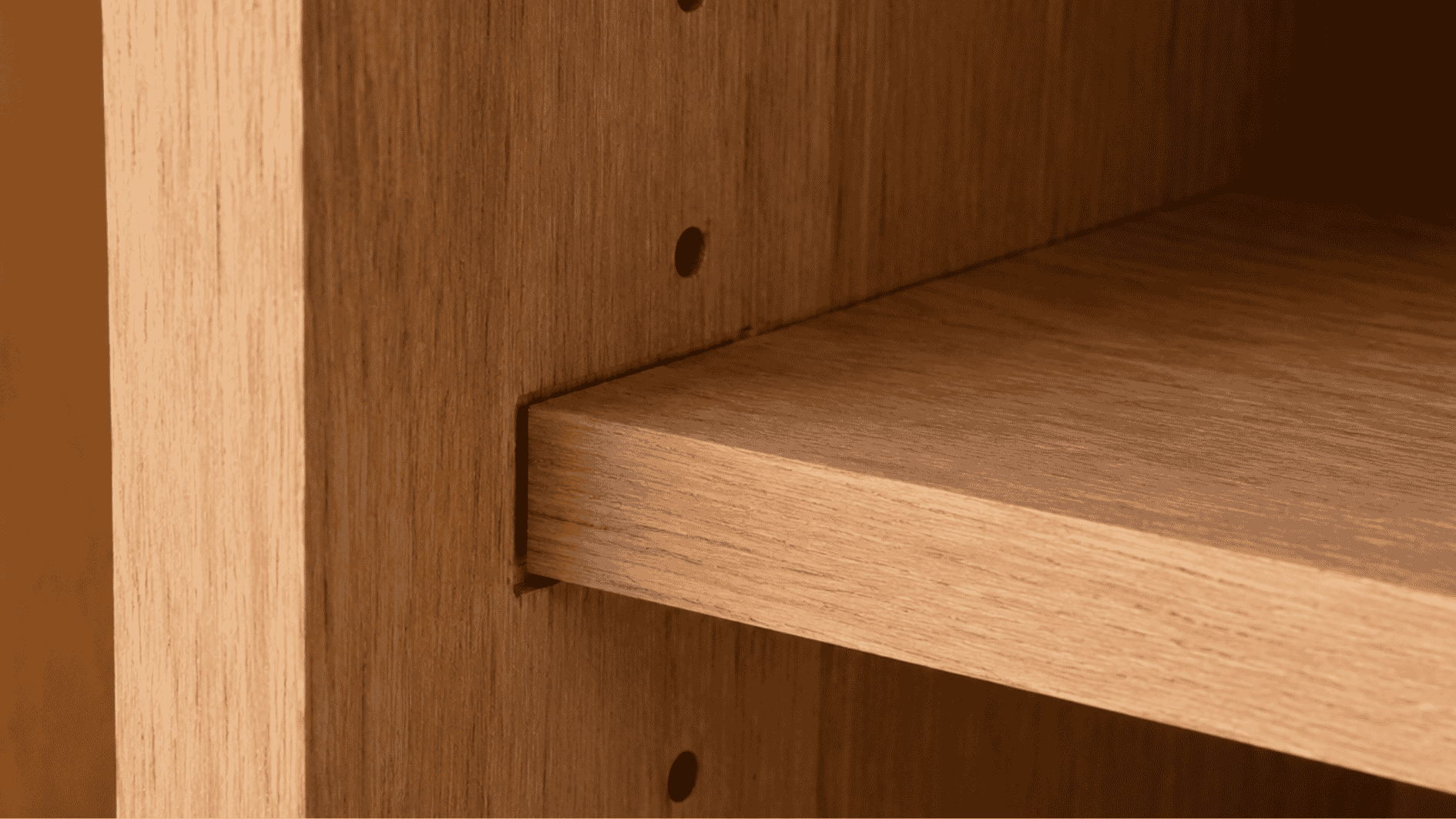

A dado joint is a groove cut into one wooden piece to hold another piece securely in place. It creates strong support for horizontal wooden components.
Dado joints are widely used in bookshelves, cabinets, and storage units. Unlike rabbet joints, dado joints are cut across the wood surface rather than along the edge.
Application: Used to support shelves and panels securely inside another wood piece. Common in cabinets, bookshelves, storage units, and shelving systems.
8. Rabbet Joint

A rabbet joint is formed by cutting a recessed edge along the side of a wooden piece. This allows another piece of wood to fit into the cut section for better alignment.
Rabbet joints are commonly used in cabinets, drawers, and wooden boxes. The design improves support and helps create cleaner corner connections.
Application: Used for joining edges and fitting back panels into wooden structures. Common in cabinets, drawers, boxes, and frame construction.
9. Tongue and Groove Joint

A tongue and groove joint uses a projecting tongue on one board that fits into a matching groove on another board. This creates a secure and aligned connection between wooden panels.
These joints are commonly used in flooring, wall paneling, and ceiling installations. They also allow slight wood movement caused by expansion and contraction.
Application: Used for connecting boards evenly while keeping them aligned and stable. Common in wood flooring, wall paneling, ceilings, and wooden decking.
10. Biscuit Joint

A biscuit joint uses small oval-shaped wooden biscuits placed inside matching slots cut into two wood pieces. Wood glue is then applied to strengthen the connection.
This method is commonly used in tabletops, cabinets, and furniture assembly. Biscuit joints mainly improve alignment and surface stability during assembly.
Application: Used to align wood pieces accurately while adding hidden reinforcement. Common in tabletops, furniture panels, cabinet work, and edge-joining projects.
11. Pocket Hole Joint

A pocket hole joint uses angled holes and screws to connect wooden parts quickly and securely. It is one of the fastest joinery methods used in modern woodworking.
Pocket hole joints are popular in DIY furniture projects, cabinet making, and home woodworking. The method allows faster assembly with minimal visible fasteners.
Application: Used for quick and easy furniture assembly with hidden screw connections. Common in DIY furniture, cabinets, tables, and woodworking repair projects.
12. Dowel Joint

A dowel joint uses wooden pins inserted into matching holes drilled into two wood pieces. The dowels help improve alignment and strengthen the connection.
This joint is commonly used in furniture assembly and panel construction. Accurate drilling and alignment are important for creating strong and stable dowel joints.
Application: Used for hidden reinforcement while maintaining a clean wood surface appearance. Common in furniture assembly, cabinet construction, and panel joining projects.
How to Choose the Right Wooden Joint for Your Project
Choosing the right wooden joint starts with understanding the stress it will face, vertical load, racking force, or tension, and selecting a joint built to handle it.
Consider whether the joint will be visible or hidden in the finished piece. Exposed joints should be as beautiful as they are strong; hidden ones should prioritize speed and reliability.
- Match the joint to the load it will carry. Joints under heavy racking force need mechanical strength – mortise and tenon or dovetail. Light-duty connections can rely on simpler joints like butt or pocket holes.
- Decide whether the joint will be visible or hidden. Exposed joints should look as good as they perform – dovetail and box joints are ideal. Hidden joints can prioritize speed and ease, making pocket hole and biscuit joints the smarter choice.
- Be honest about your skill level and available tools. Start with joints your current tools and techniques can execute cleanly. A well-cut butt joint always beats a poorly cut dovetail.
Conclusion
Wooden joints play an important role in the strength, stability, and appearance of woodworking projects. Each joint type is designed for specific applications, ranging from basic wood connections to heavy-duty structural support.
Choosing the right wooden joint depends on factors such as load capacity, project type, durability, and construction style.
Strong joints like mortise and tenon or dovetail joints are often used for furniture, while simpler joints work well for quick assembly and beginner projects.
Learning different joinery methods helps improve woodworking accuracy, project quality, and long-term durability.