

Full Bed Dimensions: Size Guide & King Comparison
Shopping for a new mattress brings up a lot of questions. One of the biggest is how different bed sizes actually compare in real life.
When you look at full bed dimensions next to a king, the gap might surprise you. A full look similar on paper, but once you’re lying down, the difference is hard to ignore.
In this post, I’ll walk you through exact measurements, what the size difference feels like in use, and how each fits into your bedroom. If you sleep solo or share your bed, this comparison will help you understand exactly what you’re working with.
Full vs. King Bed Dimensions at a Glance
Before anything else, let’s get the numbers straight.
Note: All measurements in this guide follow standard US mattress dimensions. While slight variations may occur by manufacturer, these industry-recognized sizes are widely used across the United States.
A full bed measures 54 inches wide by 75 inches long. In the United States, this size is considered the standard full mattress. It is also commonly referred to as a “double bed,” though both terms describe the same dimensions.
A king bed measures 76 inches wide by 80 inches long. That’s a meaningful jump in both directions.
Here’s a simple side-by-side look:
| Feature | Full Bed | King Bed |
|---|---|---|
| Width | 54 inches | 76 inches |
| Length | 75 inches | 80 inches |
| Surface Area | 4,050 sq in | 6,080 sq in |
| Best For | Solo sleepers | Couples, families |
| Room Size Needed | Smaller rooms | Larger rooms |
One thing worth noting, some brands list full width as 53 inches. That’s just rounding.
These minor differences are due to rounding or manufacturing tolerances, but the official US standard for a full mattress remains 54 inches wide by 75 inches long.
A full is not half of a king. Both the width and length are different, so don’t let the naming confuse you.
Standard US Mattress Size Chart
| Mattress Size | Dimensions (Inches) | Dimensions (Centimeters) | Best For |
|---|---|---|---|
| Twin | 38″ × 75″ | 96.5 × 190.5 cm | Children, single sleepers |
| Twin XL | 38″ × 80″ | 96.5 × 203.2 cm | Taller individuals, dorm rooms |
| Full (Double) | 54″ × 75″ | 137.2 × 190.5 cm | Solo sleepers, smaller rooms |
| Queen | 60″ × 80″ | 152.4 × 203.2 cm | Couples, guest rooms |
| King | 76″ × 80″ | 193 × 203.2 cm | Couples, families |
| California King | 72″ × 84″ | 183 × 213.4 cm | Taller sleepers |
Dimensions are listed in both inches and centimeters for convenience. While inches are the standard unit in the United States, metric conversions are included for international readers.
How Much Bigger as a King Bed than a Full
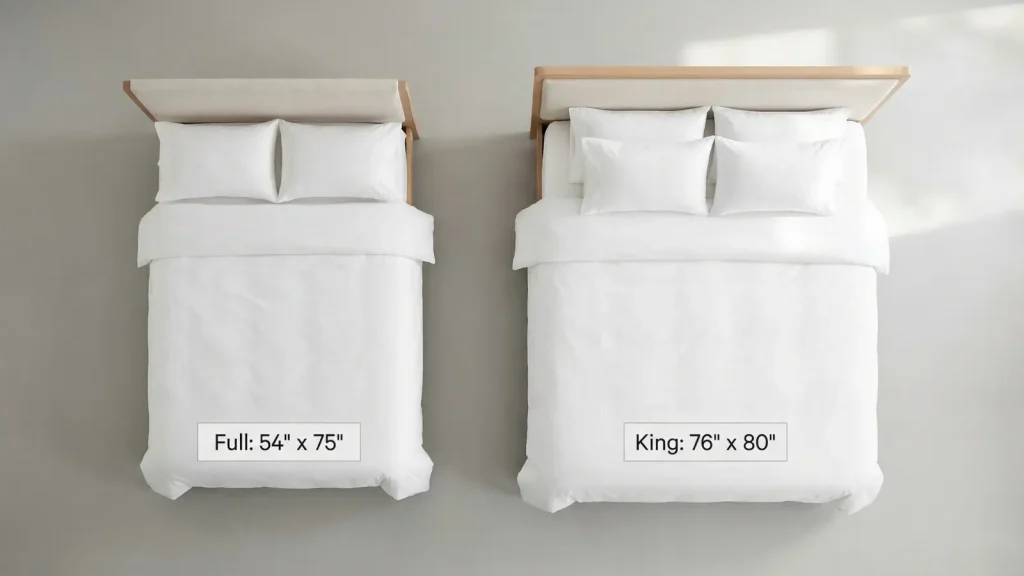
The king is significantly larger, and the numbers back that up clearly.
In terms of width, the king is about 22 inches wider than a full. That’s nearly two extra feet of sleeping space from side to side. In terms of length, the king adds about 5 more inches.
When you look at total surface area, the difference gets even clearer:
- Full: ~4,050 square inches
- King: ~6,080 square inches
That means a king offers roughly 50% more sleeping surface than a full. It’s not a minor upgrade; it’s a significant size jump.
A lot of people assume the difference between standard sizes is small. It’s not. That extra width is what you feel most on a daily basis.
What the Size Difference Means in Real Use
Raw numbers only tell part of the story. What matters more is how each size actually performs when you’re using it every night.
A full bed is designed for one person. It gives a single adult enough room to sleep comfortably without feeling cramped. For two people, though, it gets tight fast. There’s limited space to move, and any shifting from one side tends to disturb the other.
A king is built for shared sleeping. It gives two adults real room to spread out without crossing into each other’s space. It also works well for families where kids or pets end up in the bed.
Personal Space Per Sleeper
This is where the size difference becomes most obvious.
When two people share a full bed, each person gets about 27 inches of width. That’s roughly the same as a twin bed. It’s functional, but there’s no room to spare.
On a king, each person gets about 38 inches. That’s a full 11 extra inches per side, enough to move freely without disturbing your partner.
For context, a standard twin is 38 inches wide. So sleeping on one side of a king is about the same as having your own twin.
Room Size Impact and Layout Constraints
A bigger bed needs a bigger room. That sounds obvious, but it’s easy to underestimate how much floor space a king actually takes up once it’s in place.
A full bed fits comfortably in smaller rooms. It leaves enough space for a nightstand or two and still allows easy movement around the frame.
A king bed needs significantly more room. Most interior guidelines suggest at least 2 to 3 feet of walking clearance on each open side of the bed.
According to common US interior design guidelines, a full bed fits comfortably in rooms measuring at least 10 × 10 feet, while a king bed is best suited for rooms measuring 12 × 12 feet or larger.
These recommendations allow for adequate walking clearance and functional furniture placement.
Movement Space Around the Bed
Getting the clearance right isn’t just about comfort; it affects how functional your whole room feels.
Here’s what to keep in mind:
- Leave at least 2 feet on the sides you walk along daily
- Allow 3 feet if the space doubles as a walkway to a closet or bathroom
- Factor in door swing, a king pushed too close can block a door from opening fully
- Wardrobe and dresser placement becomes more limited with a king in the room
A king bed that crowds the room ends up feeling less comfortable, not more. The bed itself might be spacious, but a cramped layout cancels that out quickly.
When a Full and King Feel Similar (and When They Don’t)
There are situations where the size difference matters a lot, and a few where it barely registers.
They feel similar when:
- One person sleeps alone in either size
- The sleeper tends to stay in one position through the night
- The bedroom is small, and layout matters more than the sleeping surface
They feel very different when:
- Two people share the bed regularly
- One or both sleepers move around a lot at night
- Either sleeper is taller and needs that extra 5 inches of length the king provides
The key takeaway here is that bigger doesn’t always feel better by default. It depends entirely on how you use the bed.
Common Misconceptions About Full vs. King Beds
A few myths keep showing up when people compare these two sizes. It’s worth clearing them up.
A full is half of a king: This is false. The width difference is 22 inches, and the length differs too. They’re separate sizes, not halves of each other.
Full works fine for couples: It can work short-term, but it’s not designed for two adults long-term. The 27 inches per person leaves very little room to move.
Both sizes have the same length: Not true. A king is 5 inches longer, which matters for taller sleepers.
Full and double are different sizes: In US mattress terminology, “full” and “double” are interchangeable names for the same bed size. Both measure 54 inches wide by 75 inches long and follow standard industry specifications.
These mix-ups usually come from the names, not the measurements. Always go by the numbers.
Quick Comparison Summary
Here’s a fast recap of everything covered:
- A full bed is 54″ × 75″: best for single sleepers or smaller rooms
- A king bed is 76″ × 80″: built for two adults with room to spare
- The king is 22 inches wider and 5 inches longer
- King offers about 50% more surface area than a full
- The biggest difference is width, not length
- Room size matters: a king needs more floor space and clearance to work well
Both are solid options depending on your situation. The full makes sense when space is tight, or you sleep solo. The king makes sense when you share your bed and want real personal space.
Conclusion
Understanding full bed dimensions compared to a king comes down to a few key numbers. The king is 22 inches wider, 5 inches longer, and offers about 50% more sleeping surface.
That difference is minor for solo sleepers but significant for couples.
A full fits well in smaller rooms and works great for one person. A king needs more space but delivers more comfort when two people share it.
Now that you know what the measurements actually mean in real life, you can make a much clearer call on which size fits your bedroom and your sleep style.
Frequently Asked Questions
Is a Full Bed the Same as a Double Bed?
A full bed and a double bed are exactly the same size. “Double” is just an older name for the full. Both measure 54 inches wide by 75 inches long. The names are used interchangeably, but the dimensions never change.
Can a Full Bed Fit Two Adults Comfortably Long-Term?
A full can fit two adults, but it’s not ideal long-term. Each person gets about 27 inches of space, roughly the width of a twin. It works if both sleepers stay close and don’t move much. For regular shared sleeping, most adults find it too tight over time.
What Room Size Do You Need for a King Bed?
A king bed needs at least a 12 x 12 foot room to fit comfortably. That gives you enough space for the mattress plus 2–3 feet of clearance on the sides. If you want room for nightstands and a dresser too, aim for 13 x 13 feet or larger.
Is a King Bed the Same as Two Twin XL Beds?
Yes, two twin XL mattresses placed side by side equal the dimensions of a standard king. Each twin XL is 38 inches wide by 80 inches long. Together, they match the king’s 76 x 80 inch size exactly. This setup is common for split-king adjustable bed frames.


