21 Fall Window Box Ideas: A Guide to Plants, Timing, and Care
Your window boxes may still hold summer petunias, even as cooler mornings arrive. Fall planting isn’t just about looks; timing and frost tolerance matter, too.
These fall window box ideas are organized by sun, shade, and style, with simple planting and care tips to help your display last through the season.
When to Plant Your Fall Window Box
Most gardeners across the US should plant fall window boxes between early September and mid-October, once nighttime temperatures settle into the 50s Fahrenheit.
Planting too early, while the soil is still summer-warm, can stress cold-loving plants like mums and ornamental kale before they can root. Planting too late risks losing tender plants to an early frost before the box has time to fill out.
Your exact timing depends on where you live. Homeowners in northern states and cooler hardiness zones should plant by early to mid-September to get a full display before hard frost arrives, while those in southern or milder zones can wait into October or even November.
Check your local first frost date and hardiness zone through the USDA Plant Hardiness Zone Map before you buy plants, so an early cold snap does not catch you off guard.
21 Fall Window Box Ideas
These 21 fall window box ideas cover every sun level, budget, and style, from classic mums to no-fuss artificial arrangements. Pick the ones that match your window’s light and your own maintenance style.
1. Mums, Pansies, and Ornamental Grass Trio

This is the combo most people think of first when they hear “fall window boxes,” and it earns that spot. Chrysanthemums bring bold color, pansies fill in low and bloom through light frost, and a small ornamental grass adds height and movement without crowding the box.
Best for: Full sun to part sun
Care tip: Water mums at the soil line rather than overhead, since wet blooms turn mushy fast.
2. Flowering Kale and Cabbage Rosettes

Flowering kale and ornamental cabbage look almost like giant roses once cooler weather deepens their color. They hold their shape for months and get even more colorful as temperatures drop, making them one of the longest-lasting picks on this list.
Best for: Full sun to part shade
Care tip: Color intensifies after the first light frost, so do not judge this one too early in the season.
3. Pumpkins and Gourds Nestled in Greenery
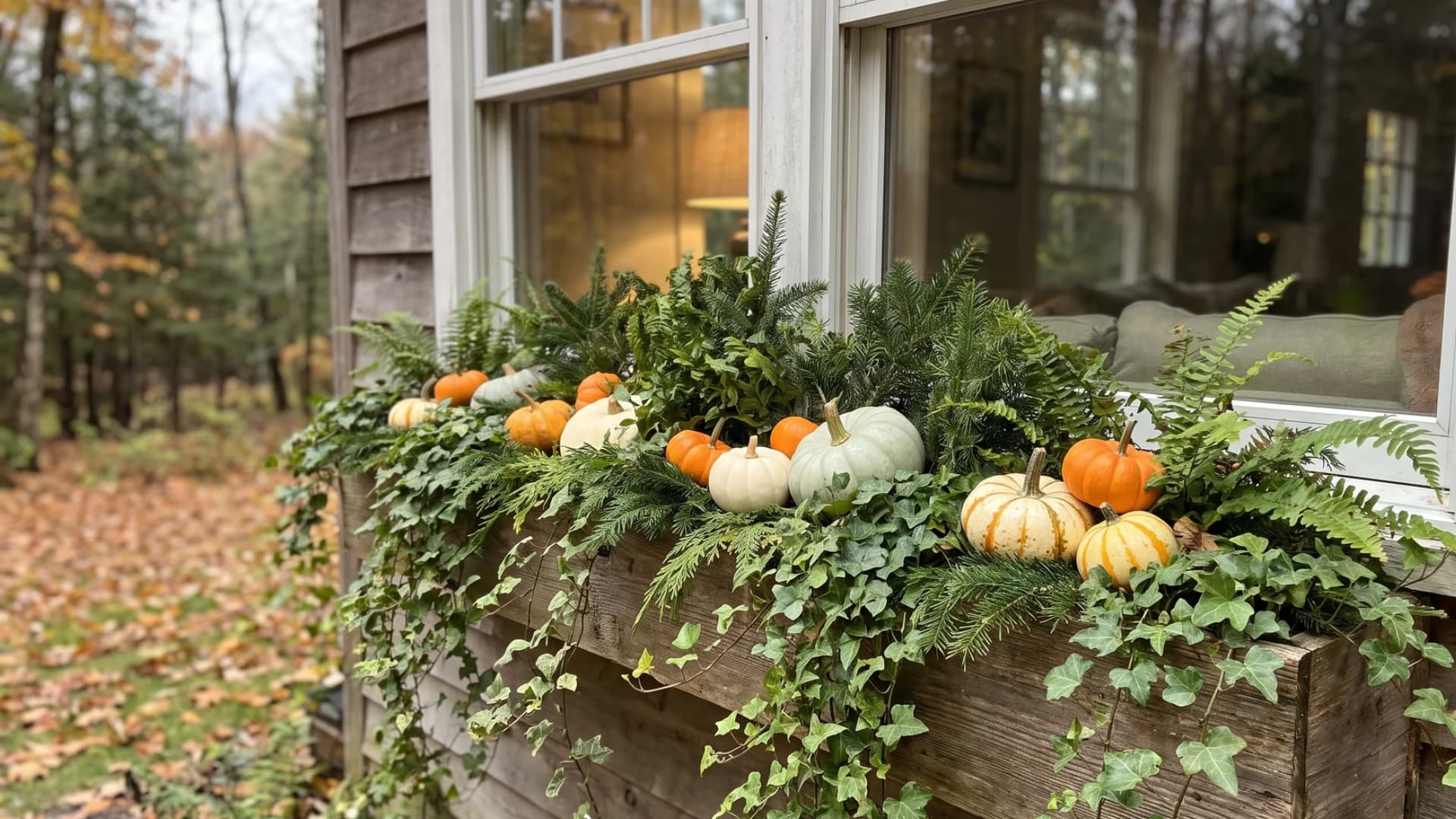
Skip flowers altogether and build the box around a base of trailing ivy or greenery, then tuck in mini pumpkins and gourds in different shapes and colors. It is one of the easiest fall window boxes to put together, and it holds up well through cooler, wetter weeks.
Best for: Full sun or shade, any style
Care tip: Choose mini pumpkins over full-size ones so the weight does not strain the box brackets.
4. Copper and Rust-Toned Coleus Mix

Coleus is usually thought of as a summer plant, but the copper, rust, and burgundy varieties fit fall color schemes perfectly. Paired with a trailing plant along the edge, it fills a box fast without needing a single flower.
Best for: Part shade
Care tip: Bring a stem cutting indoors before frost, root it in water, and replant next spring.
5. White and Silver Dusty Miller Display
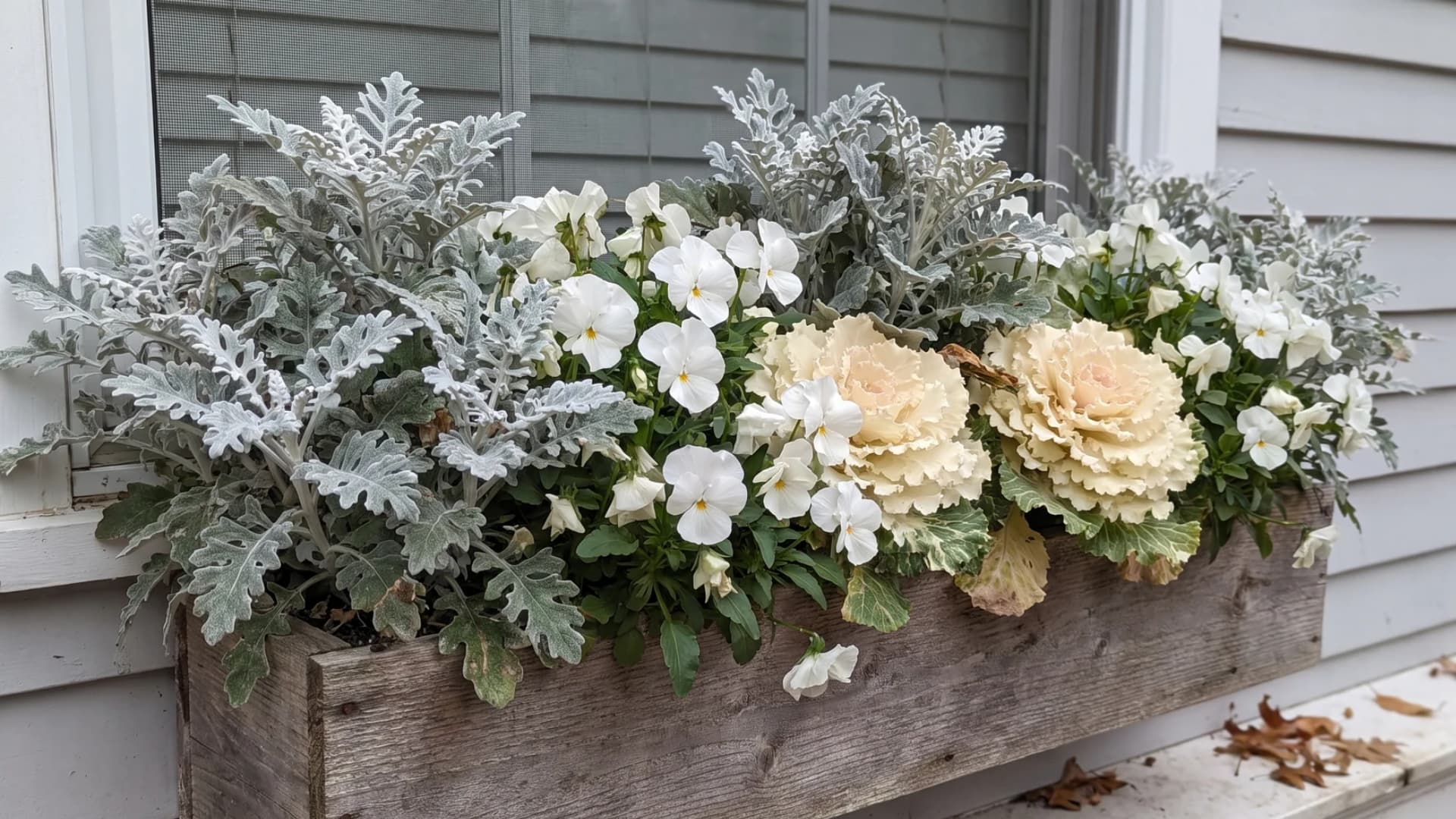
For a quieter, more refined look, pair silvery dusty miller foliage with white pansies or white ornamental kale. It reads as refined rather than seasonal, so it works for homeowners who want a fall box that still matches a neutral exterior.
Best for: Full sun to part sun
Care tip: Dusty miller handles dry stretches better than most fall foliage, so it forgives an occasional missed watering.
6. Wine and Burgundy Heuchera Blend

Heuchera, also called coral bells, brings deep wine and burgundy foliage that lasts well past fall since it is a true perennial. Mix it with a few orange mums for contrast, and you get a box with real depth of color, one that holds up without direct sun.
Best for: Part sun to part shade
Care tip: Heuchera survives winter in most zones, so it can stay in the box year after year instead of being replaced each season.
Full sun combos
7. Marigolds and Ornamental Peppers

Marigolds hold up in full sun and dry conditions better than most fall flowers, and pairing them with ornamental peppers adds color that lasts into late fall. Ornamental peppers are grown for looks, not eating, so keep them away from pets and small children who might try a taste.
Best for: Full sun
Care tip: Ornamental peppers shift color as they mature, moving from yellow and orange into deep purple.
8. Snapdragons with Dwarf Cypress
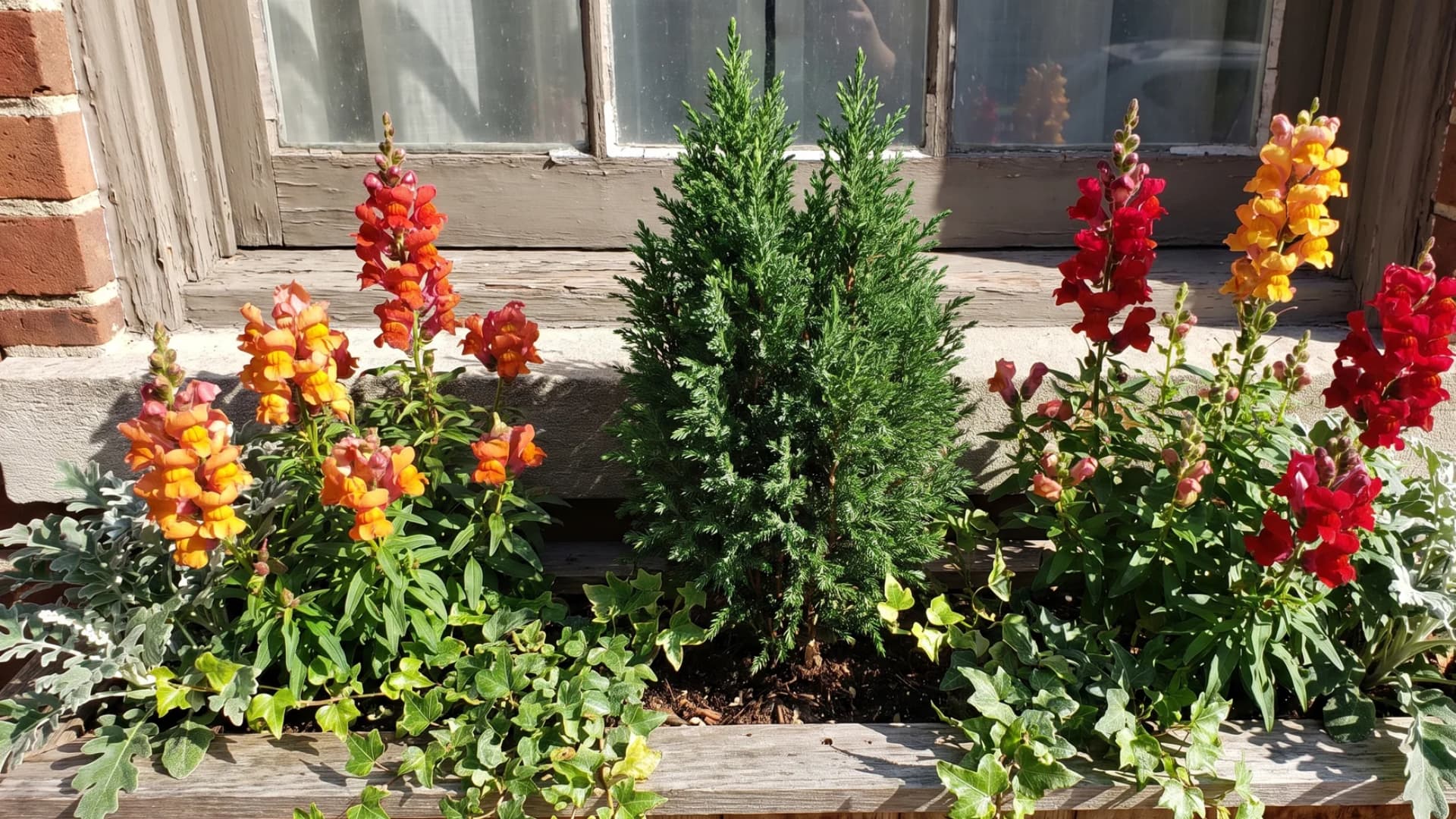
Snapdragons add vertical color in shades of orange, yellow, and deep red, while a small dwarf cypress in the center gives the box evergreen structure that lasts beyond the flowers.
Best for: Full sun
Care tip: Snapdragons often rebloom after a light trim, so do not pull them at the first sign of fading flowers.
9. Sedum and Succulent Rock Garden Box
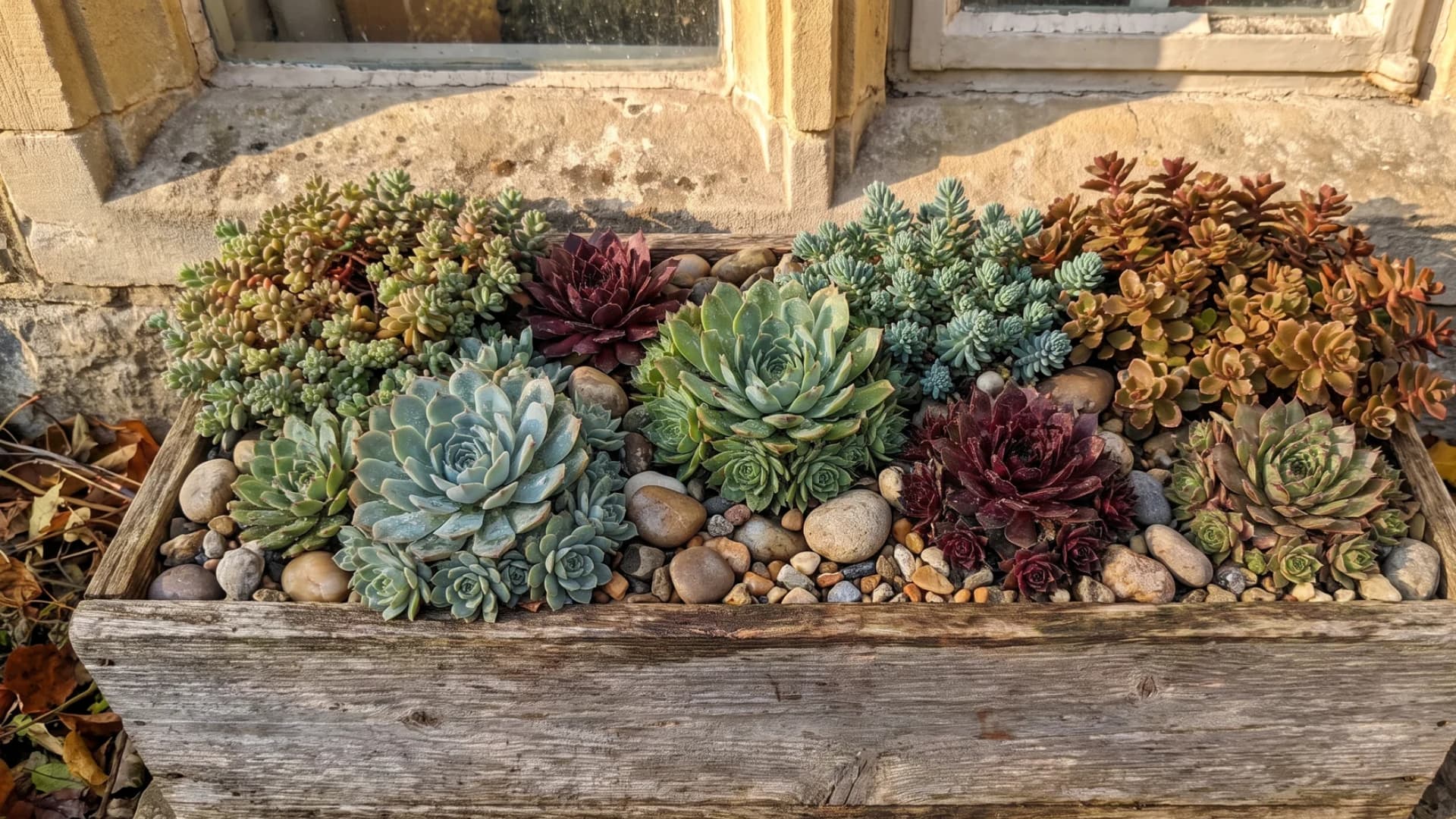
For a completely different texture, fill a box with hardy sedum and succulents over a layer of small gravel. Some hardy sedum varieties tolerate temperatures well below freezing, which makes this one of the toughest low-water options on this list.
Best for: Full sun, dry climates
Care tip: Cut back watering almost completely once nights turn cool, since succulents rot faster in cold, wet soil.
10. Ivy, Fern, and Heuchera Layered Box

North-facing windows do not have to skip fall color. Trailing ivy along the edge, a compact fern for texture, and heuchera for color together make a layered box that fills in well without direct sun.
Best for: Shade to part shade
Care tip: Shaded boxes hold moisture longer, so check soil before watering rather than sticking to a fixed schedule.
11. Swiss Chard and Violas

Swiss chard brings bold red and yellow stems that read as fall color even without a single flower, and violas tucked around the base add small pops of purple and yellow that keep blooming in cooler, shadier spots.
Best for: Part shade
Care tip: Chard is fully edible, so this box doubles as a small harvest if you want to use a few leaves in the kitchen.
12. Hosta and Ornamental Kale Pairing

A small hosta clump paired with ornamental kale gives a shaded box real texture, mixing broad green leaves with the ruffled purple and cream of the kale. It reads as more of a foliage garden than a typical fall planter.
Best for: Shade
Care tip: Hosta dies back in winter, so plan to swap it for an evergreen once the leaves fade.
Halloween and Thanksgiving themed:
13. Mini Pumpkin and Black Pansy Halloween Box

Black or deep purple pansies against orange mini pumpkins make a Halloween box that still looks like a real garden, not a costume shop display. Add a few dried twigs for a slightly spooky edge.
Best for: Full sun to part sun
Care tip: True black pansies are rare, so look for deep purple varieties that read as black from a distance.
14. Skeleton and Dried Corn Spooky Display

Small skeleton figurines tucked among dried corn stalks and ornamental grass give a fall window box a playful Halloween theme without a single live flower, making it an easy weekend project.
Best for: Any sun level
Care tip: Anchor lightweight decor pieces so they do not blow away in fall wind.
15. Harvest Cornucopia With Indian Corn and Wheat

Bundles of Indian corn, dried wheat, and small gourds arranged like a harvest basket bring a warm, traditional look that works well from October straight through Thanksgiving.
Best for: Any sun level
Care tip: Keep dried elements covered, or bring them in during heavy rain, so they don’t mold.
16. Thanksgiving Gratitude Box With Gourds and Marigolds

Warm gold marigolds mixed with an assortment of small gourds make a Thanksgiving-forward box that still has living color, rather than relying only on dried decor.
Best for: Full sun
Care tip: Marigolds keep blooming later into fall than most flowers, so they hold up well through late November.
17. Dried Flower and Wheat Bundle Box
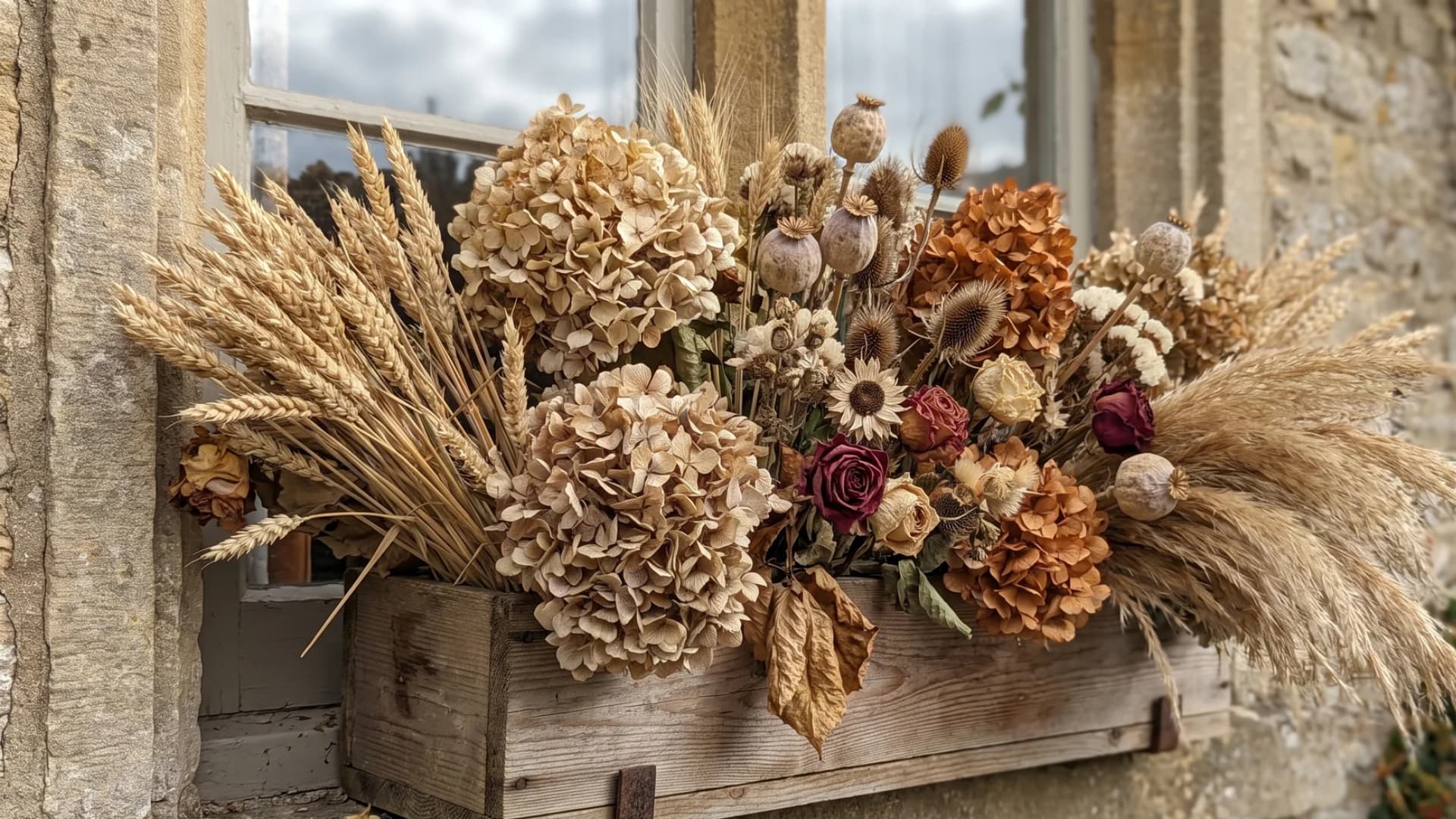
Dried flowers and wheat bundles need no water or sunlight at all, making them a good option for a quick refresh before guests arrive or a short-term display for an open house.
Best for: Any sun level, temporary displays
Care tip: Bring bundles indoors during heavy rain or wind to keep them intact longer.
18. UV Resistant Artificial Fall Foliage

Modern UV-resistant artificial stems hold their color through sun, rain, and freezing temperatures, making them a practical choice for high, hard-to-reach window boxes that are difficult to water regularly.
Best for: Any sun level, low maintenance
Care tip: Choose stems rated for outdoor UV exposure, since indoor artificial florals fade fast outside.
19. Evergreen Base With Swappable Seasonal Accents

Plant a small evergreen, like dwarf boxwood or juniper, as a permanent base, then simply swap seasonal accents like mini pumpkins or dried grass around it each year instead of replanting the whole box.
Best for: Any sun level, long-term boxes
Care tip: This approach cuts your fall planting cost since you only need to replace the accents each season.
20. Rosemary, Sage, and Thyme Herb Box

Cold-hardy herbs like rosemary, sage, and thyme keep producing right through the first frost, giving you fresh ingredients for fall cooking while still looking full and green in the window.
Best for: Full sun
Care tip: Rosemary tolerates drier soil than most fall plants, so avoid overwatering it in this mix.
21. Kale and Swiss Chard Edible Harvest Box
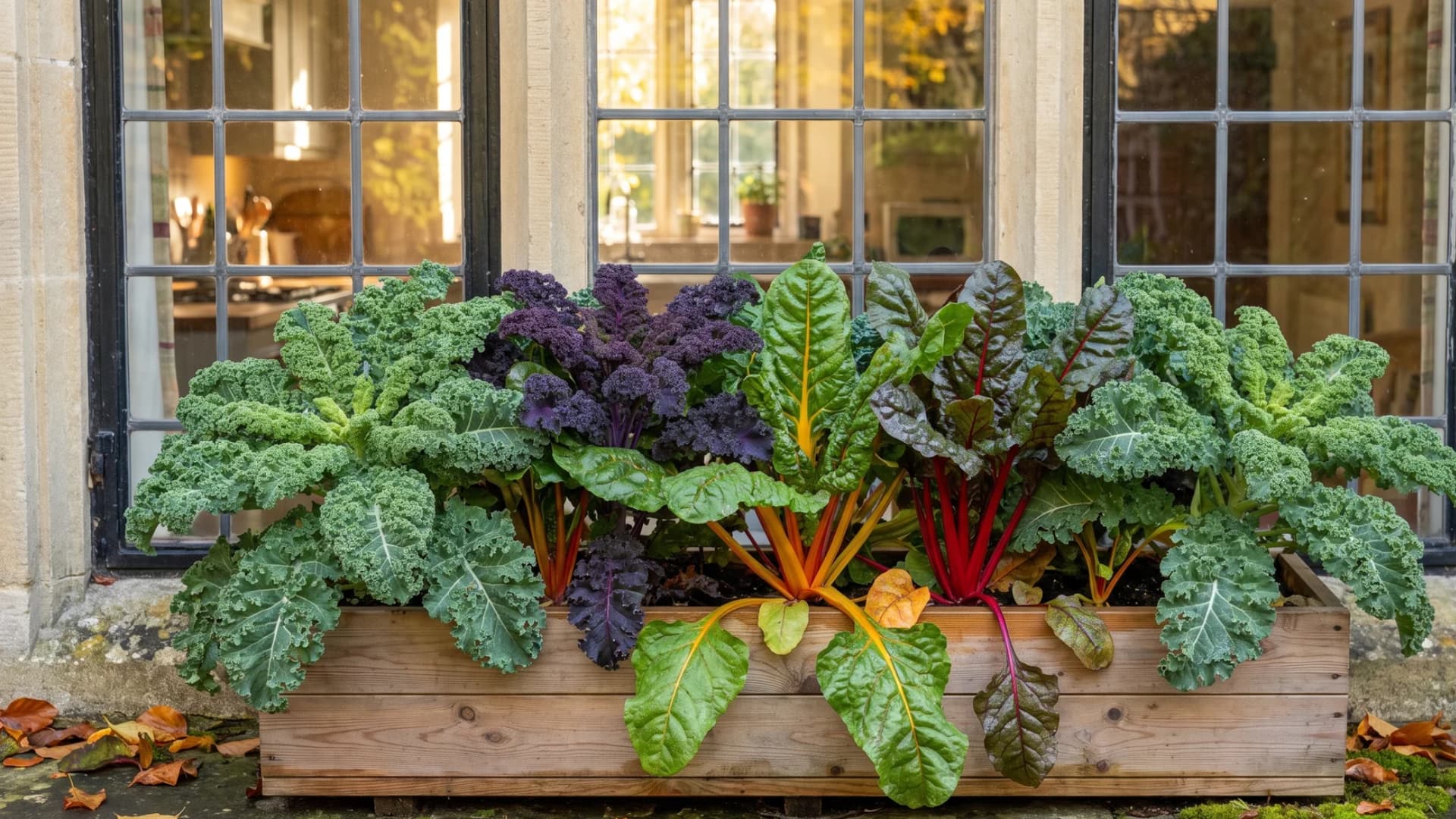
Edible kale and Swiss chard look just as good as their ornamental cousins but double as a real harvest, so you can snip a few leaves for dinner while the box still looks full from the street.
Best for: Full sun to part shade
Care tip: Harvest outer leaves first and let the center keep growing for a longer season.
Fall Window Box Care: Watering, Frost, and Swapping to Winter
A fall window box needs a different care routine than the summer one you just replaced. Here is what changes once temperatures start to drop.
-
Watering: Cooler air holds soil moisture longer than summer heat does, so water only when the top inch of soil feels dry, usually every 4 to 7 days instead of daily.
-
Frost Protection: Pansies, ornamental kale, and heuchera handle a light frost fine, but tender plants like coleus and sweet potato vine should come out or move indoors before the first hard freeze.
-
Swapping to Winter: Once mums and pansies fade for good, swap in evergreen cuttings, dried branches, or artificial greenery so the box still looks finished through the coldest months.
How to Plant a Fall Window Box in 5 Steps

Once you know your planting window, the process itself is simple. Follow these five steps to get your fall window boxes ready in under an hour.
Step 1: Clear Out Summer Annuals and Refresh the Soil
Pull out spent summer plants and roots, then loosen the old soil or mix in a few inches of fresh potting mix so fall plants have room to settle in.
Step 2: Check and Clear the Drainage Holes
Make sure every drainage hole is open, since fall rain sits in soil longer than summer showers and soggy roots rot fast.
Step 3: Arrange Plants Using the Thriller, Filler, Spiller Method
Place one tall upright plant toward the back, fill around it with bushy plants, and let a trailing plant drape over the front edge.
Step 4: Water Deeply Right After Planting
Give the box a slow, deep watering the day you plant, then let the top inch of soil dry out between waterings as temperatures drop.
Step 5: Add Pumpkins, Corn, or Branches Last
Wait until the plants are settled in before tucking in mini pumpkins, dried corn, or branches, so you don’t disturb the roots during the finishing touches.
Real vs. Artificial Fall Florals: Which Should You Use
Real and artificial fall florals each have a place in a window box, and the right choice depends on your budget and how much upkeep you want. Here is how they compare side by side.
|
Factor |
Real Flowers and Foliage |
Artificial Flowers and Foliage |
|---|---|---|
|
Upfront cost |
Usually lower per plant |
Higher upfront, reused for years |
|
Ongoing maintenance |
Needs regular watering and deadheading |
Needs only occasional dusting or rinsing |
|
Frost tolerance |
Varies by plant; some die at the first hard freeze |
Unaffected by frost or freezing temperatures |
|
Look up close |
More natural texture, scent, and color variation |
Can look flat without UV-resistant, high-quality pieces |
|
Best for |
Homeowners who enjoy hands-on gardening |
Busy homeowners or hard-to-reach window boxes |
Mistakes to Avoid With Fall Window Boxes
One mistake I made the first year I planted fall window boxes was leaving summer petunias in too long, waiting for one more warm week that never came. By the time I finally swapped them for mums, the plants did not have enough time to fill in before the first frost hit.
I also learned the hard way that packing a box too full looks great on day one but leads to mildew and rot once fall rain sets in, since the plants cannot get enough air between them. Skipping the drainage check is another common slip, since fall rain is heavier and slower to dry than summer showers, and a blocked hole can drown roots within days.
Planting warm-season plants like petunias or sweet potato vine too late in the season is the fastest way to lose an entire box overnight, so match what you plant to your actual local frost date instead of the calendar on the wall.
Conclusion
Fall window boxes do not have to sit empty once summer fades.
With ideas to choose from, plus a clear planting timeline and real care tips, you now have what you need to build a box that lasts through Halloween, Thanksgiving, and the first frost.
Start with one idea that matches your sun and style, plant it this week, and watch how much warmth it adds to your porch. Pick your favorite idea today and plant it this weekend.
Frequently Asked Questions
What to put in window boxes for fall?
Mix cold-hardy flowers like mums, pansies, and ornamental kale with fall foliage such as coleus or heuchera. Add texture with ornamental grasses, then finish with a few mini pumpkins, gourds, or dried corn for a seasonal touch.
What flowers can I grow in planters in the fall?
Pansies, violas, mums, snapdragons, and flowering kale all grow well in fall planters and tolerate cooler nights. Heuchera and dianthus are hardy perennial options that come back the following year.
What should you not plant in the fall?
Avoid warm-season annuals like petunias, sweet potato vine, and most tropical foliage, since they stall or die back as soon as temperatures drop. Skip plants rated for zones warmer than your own, since they will not survive even a light frost.
How long do fall window boxes last?
A well-planted fall window box typically lasts 8 to 12 weeks, from early September through the first hard freeze. Frost-hardy plants like pansies and kale can last even longer in milder climates. You can check average first frost dates for your area through the Old Farmer’s Almanac frost date lookup.
Do fall window boxes need full sun?
No. Many fall favorites, including heuchera, violas, and ornamental kale, tolerate part shade well. Full sun helps flowering plants like mums and marigolds bloom longer, but shade-friendly combos work fine for north-facing windows.
Can you leave pumpkins in a window box all season?
Small pumpkins and gourds can stay in a window box for several weeks, but they soften once temperatures repeatedly drop below freezing. Swap them out once you see soft spots, or check them weekly after the first hard frost.