Deck vs. Patio: Which is Better for Your Yard?
Choosing the right outdoor space can feel simple at first. Then the questions start. Do you build up or stay at ground level? Do you invest more now or save and keep things simple?
When comparing deck vs. patio, the decision goes far beyond looks. It affects cost, maintenance, resale value, and even how your yard functions long term.
Small details like yard slope, door height, and privacy needs can completely change the answer.
Today, I’ll show you how both options compare in structure, durability, value, and real-world use so you can move forward with confidence.
What is the Difference Between a Deck and a Patio?
When planning your outdoor space, these two terms come up a lot. But they’re quite different in how they’re built and how they feel.
The biggest difference is elevation. A deck is raised off the ground, while a patio sits directly on it. That one factor changes everything, from cost to maintenance to how your space looks and feels.
What is a Deck?
A deck is an elevated outdoor platform usually attached to the back or side of your home. It’s typically built from wood or composite materials and sits above ground level.
Decks work especially well when:
- Your yard has uneven or sloped terrain
- You want a seamless exit from an upper-level door
- You’re looking for open views of your surroundings
Because they’re raised, decks can create usable outdoor space even where a flat surface wouldn’t be possible.
What is a Patio?
A patio is a ground-level outdoor surface built directly on the ground. It’s usually made from concrete, stone, brick, or pavers.
Patios work great when:
- Your yard is flat and even
- You want a low-maintenance outdoor space
- You prefer a natural, grounded feel with easier landscaping around it
Unlike a deck, a patio blends more naturally into the yard, making it feel like an extension of the landscape itself.
Deck vs. Patio: Key Differences
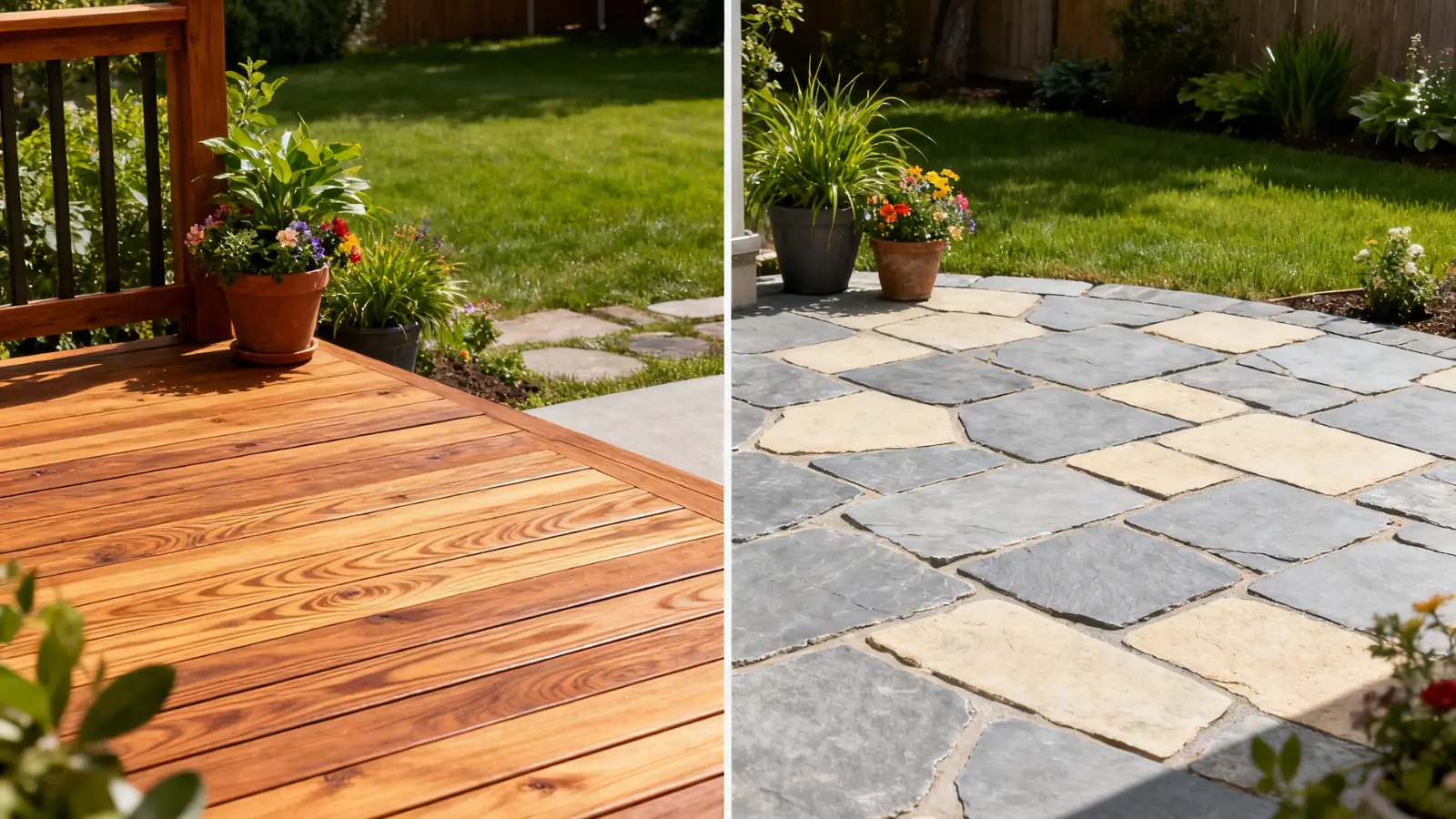
Choosing between a deck and a patio comes down to a few key factors. Here’s a simple side-by-side look at how they stack up across the things that matter most.
| Feature | Deck | Patio |
|---|---|---|
| Elevation | Raised off the ground | Ground-level |
| Best For | Sloped or uneven yards | Flat yards |
| Common Materials | Wood, composite | Concrete, stone, pavers |
| Average Cost | $8,000–$15,000+ | $3,000–$7,000 |
| Maintenance | Regular sealing/staining needed | Low maintenance |
| Durability | Prone to rot if not maintained | Highly durable |
| ROI | Higher resale value | Moderate resale value |
| Privacy | More exposed | Easier to add privacy screening |
Each option has its strengths. The right one really depends on your yard, your budget, and how you plan to use the space.
No single choice is perfect for everyone, and that’s exactly what the next sections will help you figure out.
Pros and Cons of a Deck
A deck changes how your backyard feels because it adds height and structure. That elevation is both its biggest strength and its biggest trade-off.
Why a Deck Can Be a Great Choice
The biggest advantage of a deck is flexibility.
If your yard is sloped or uneven, a deck can create usable space without heavy excavation. Instead of fighting the terrain, it builds above it. In many homes, that alone makes it the practical option.
Decks also connect well to upper-level doors. If your back door sits several feet above grade, a deck creates a smooth transition outside. Without it, you would need stairs leading down to a patio, which can feel disconnected.
There is also resale appeal. Buyers often see a well-built deck as an extension of the home rather than just a surface in the yard. That perception can translate into stronger returns compared to a patio in many markets.
And from a design standpoint, decks are highly adaptable. Multi-level layouts, built-in seating, railings, and lighting all make it feel like a defined outdoor living area.
Where a Deck Falls Short
The main downside is cost. Decks require framing, footings, posts, and structural support. That adds labor and materials, which increases the upfront price.
Maintenance is the second big factor. Wood decks need regular sealing or staining. Without upkeep, they can rot, warp, or attract insects. Composite reduces maintenance, but it increases the initial investment.
Because decks are elevated, they also offer less natural privacy. You are more visible to neighbors, especially in tightly spaced subdivisions.
Finally, most decks require permits and inspections. That adds time to the project and sometimes extra fees.
A deck makes sense when elevation solves a problem or adds value. It’s less ideal if your yard is already flat and budget is your top concern.
Pros and Cons of a Patio
A patio keeps things simple. It sits at ground level and works with the yard instead of rising above it. That simplicity is why many homeowners choose it.
Why a Patio Works so Well
Cost is the biggest advantage. Because patios don’t require structural framing, they are generally much more affordable than decks of the same size.
They are also low maintenance. Concrete, pavers, and stone can last for decades with occasional cleaning and minor repairs. There’s no sealing schedule like with wood decking.
Privacy is easier to achieve at ground level. You can add fencing, hedges, garden beds, or pergolas around the edges without feeling exposed.
Patios also tend to feel more integrated with landscaping. They blend into the yard rather than standing apart from it.
If your yard is flat and stable, a patio is often the simplest and most cost-effective way to create outdoor space.
Where a Patio Has Limits
Patios struggle on uneven terrain. If your yard slopes significantly, you may need grading, retaining walls, or additional drainage work. Those extras can quickly raise the cost.
They also don’t offer elevation. If your home’s back door sits high above ground, you will need steps leading down to the patio. That can make the space feel less connected to the house.
Concrete patios can develop cracks over time due to ground movement or freeze-thaw cycles. Pavers reduce cracking issues but may shift and require re-leveling.
In terms of resale value, patios typically provide a moderate return, but often not as strong as a well-built deck.
A patio is ideal when the yard is flat, the budget is tight, and low maintenance is a priority.
Deck vs. Patio Cost Breakdown
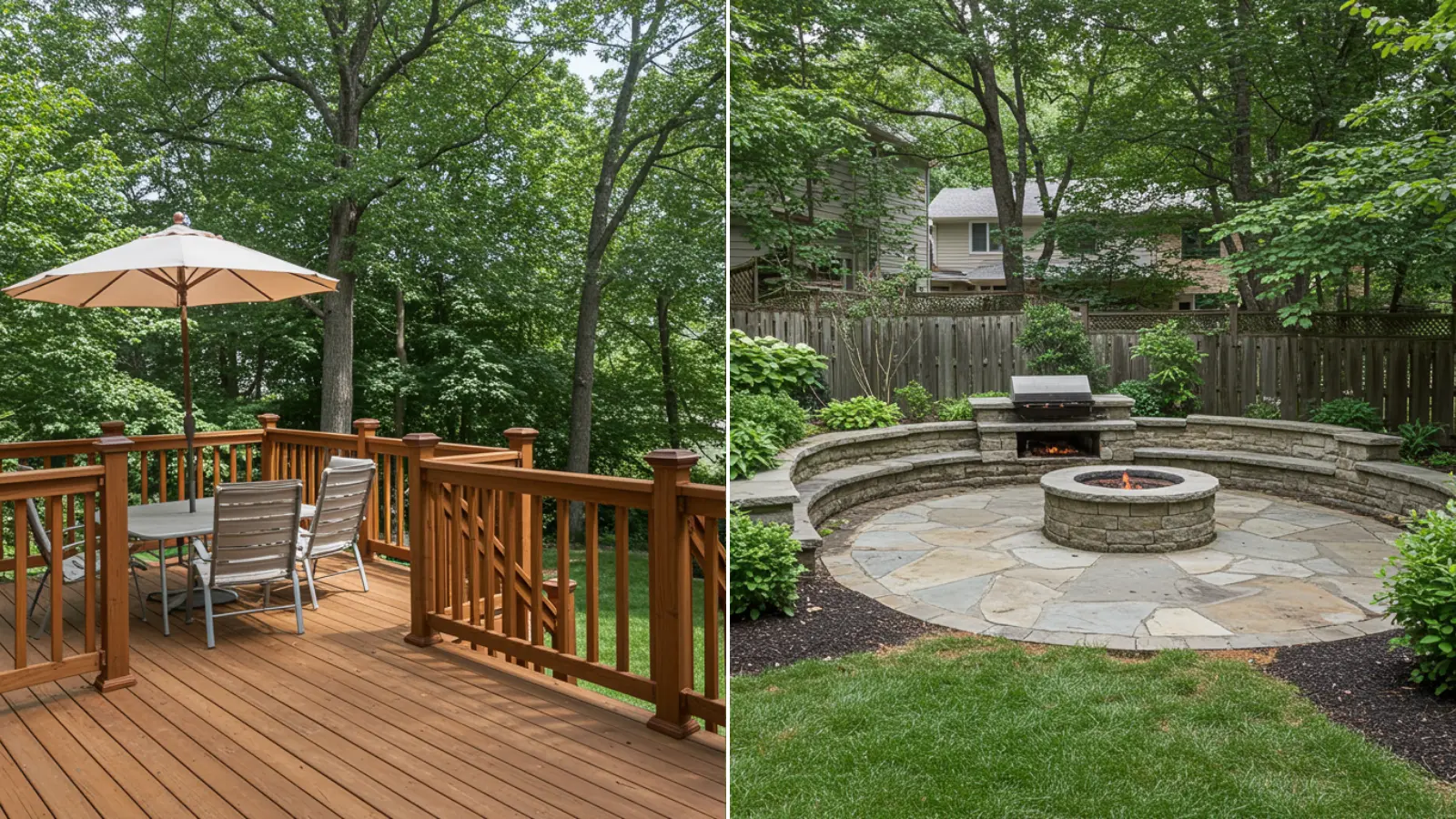
Cost is usually the deciding factor for many homeowners. And it should be. Outdoor projects can run into the thousands, so you need clear numbers before you commit.
Here’s how decks and patios compare when you break down the real costs:
Average Total Cost
For a standard 200–300 square foot space:
- Deck: $8,000–$15,000+
- Patio: $3,000–$7,000
The final number depends on materials, labor rates in your area, and how much site preparation is needed.
Cost Per Square Foot
Looking at price per square foot gives you a more accurate comparison.
| Cost Factor | Deck | Patio |
|---|---|---|
| Average Cost Per Sq. Ft. | $25–$50 | $10–$17 |
| Budget Option | Pressure-treated wood ($25–$30/sq. ft.) | Basic concrete slab ($10–$12/sq. ft.) |
| Mid-Range Option | Composite ($30–$45/sq. ft.) | Pavers ($12–$20/sq. ft.) |
| Premium Option | Hardwood or high-end composite ($45–$60+/sq. ft.) | Natural stone ($20–$35+/sq. ft.) |
Decks cost more because they require framing, footings, posts, and structural supports. Patios sit directly on the ground, so the construction process is simpler.
If your yard is sloped, costs can increase for either option. A patio may require grading or retaining walls. A deck may need deeper footings or additional structural work.
Labor and Permit Costs
- Decks: Higher labor costs due to structural framing and railing installation. Most decks require permits and inspections.
- Patios: Lower labor costs in most cases. Many ground-level patios do not require permits, depending on local codes.
Permit fees and inspections can add several hundred dollars to a deck project.
Maintenance Costs Over Time
Upfront cost is only part of the picture.
- Wood decks need sealing or staining every few years.
- Composite decks reduce maintenance but cost more initially.
- Patios typically need occasional cleaning and minor joint or crack repairs.
Over 10–15 years, deck maintenance can add a few thousand dollars in upkeep, especially for natural wood.
Resale Value and ROI
Decks generally offer a stronger return at resale.
- Deck ROI: Roughly 60%–75% of the project cost recouped
- Patio ROI: Roughly 30%–60% recouped
The exact return depends on your local housing market, materials used, and overall build quality.
If you plan to sell within a few years, a well-built deck may add more perceived value. If you plan to stay long-term, a patio can give you durable outdoor space without ongoing maintenance costs.
Bottom Line on Cost
If your main goal is to keep upfront costs low, a patio is usually the more affordable option.
If you’re thinking long-term value and stronger resale appeal, a deck may justify the higher investment.
It comes down to how much you want to spend now and how much value you want to capture later.
Which One Suits Your Needs Best?
By now, you understand the key differences. The right choice depends on your yard layout, your budget, and how you plan to use the space.
Here’s a simple side-by-side guide to help you decide:
| If This Sounds Like You… | Choose A Deck | Choose A Patio |
|---|---|---|
| Your yard is sloped or uneven | Built above uneven terrain without major grading | Requires leveling, grading, or retaining walls |
| Your back door sits above ground level | Creates a smooth, direct transition | Requires stairs down to ground level |
| You want stronger resale appeal | Typically higher ROI (60–75%) | Moderate ROI (30–60%) |
| You’re working with a tighter budget | Higher upfront cost | Lower upfront cost |
| You want minimal maintenance | Composite reduces upkeep but costs more | Concrete, stone, and pavers need little maintenance |
| Privacy is important | More exposed due to elevation | Easier to enclose with fencing or landscaping |
| You want open views | Elevated vantage point | Limited to ground-level views |
| You prefer simpler construction | Requires framing, footings, and permits | Simpler installation, often no permit required |
If your yard has elevation challenges or you want stronger resale value, a deck usually makes more sense.
If your yard is flat and you want a durable, lower-cost option with minimal upkeep, a patio is often the smarter choice.
Conclusion
Choosing between a deck vs patio is really about how your space needs to work, not just how it looks.
Each option solves a different problem, and the right choice depends on your yard, budget, and long-term plans. When you match the structure to your layout and daily use, the result feels natural and practical.
I have found that clarity comes from focusing on function first, then design.
If you are planning your outdoor space, take a closer look at your yard conditions and priorities, then move forward with the option that fits best. Start planning your setup today.