How to Propagate Jade Plant: Easy Steps & Tips
A jade plant rarely stays a single plant for long. Trim one stem, drop one leaf, and you could be looking at three or four new pots of your own.
You don’t need any special skill for this, just a clean cut, a bit of patience, and the good sense to leave the cutting alone while it works.
I found that out almost by accident, when a few pruned stems fell into a nearby pot and rooted on their own with zero effort from me.
Once you try it yourself, you’ll probably wonder why you ever bought a second plant instead of just growing one.
What is a Jade Plant?
A jade plant is a small succulent with thick, glossy leaves and sturdy stems that make it look like a tiny tree. It’s native to South Africa but has likely made its way onto a windowsill near you already.
Its biggest draw is how forgiving it is. Miss a watering or forget it for a week, and it still looks fine, which is why I recommend it to almost anyone starting with plants.
Give it decent light and basic care, and it rewards you for years. Many jade plants live for decades, growing thicker and more tree-like the longer you keep them.
That sculptural, tree-like quality is also part of why it works so well as a living accent piece in rooms designed around natural tropical themes and warm tones
It’s also a favorite gift for new homes, often called a “money plant” for good luck. That popularity is exactly why, once you own one, you’ll probably want more.
Different Methods to Propagate a Jade Plant
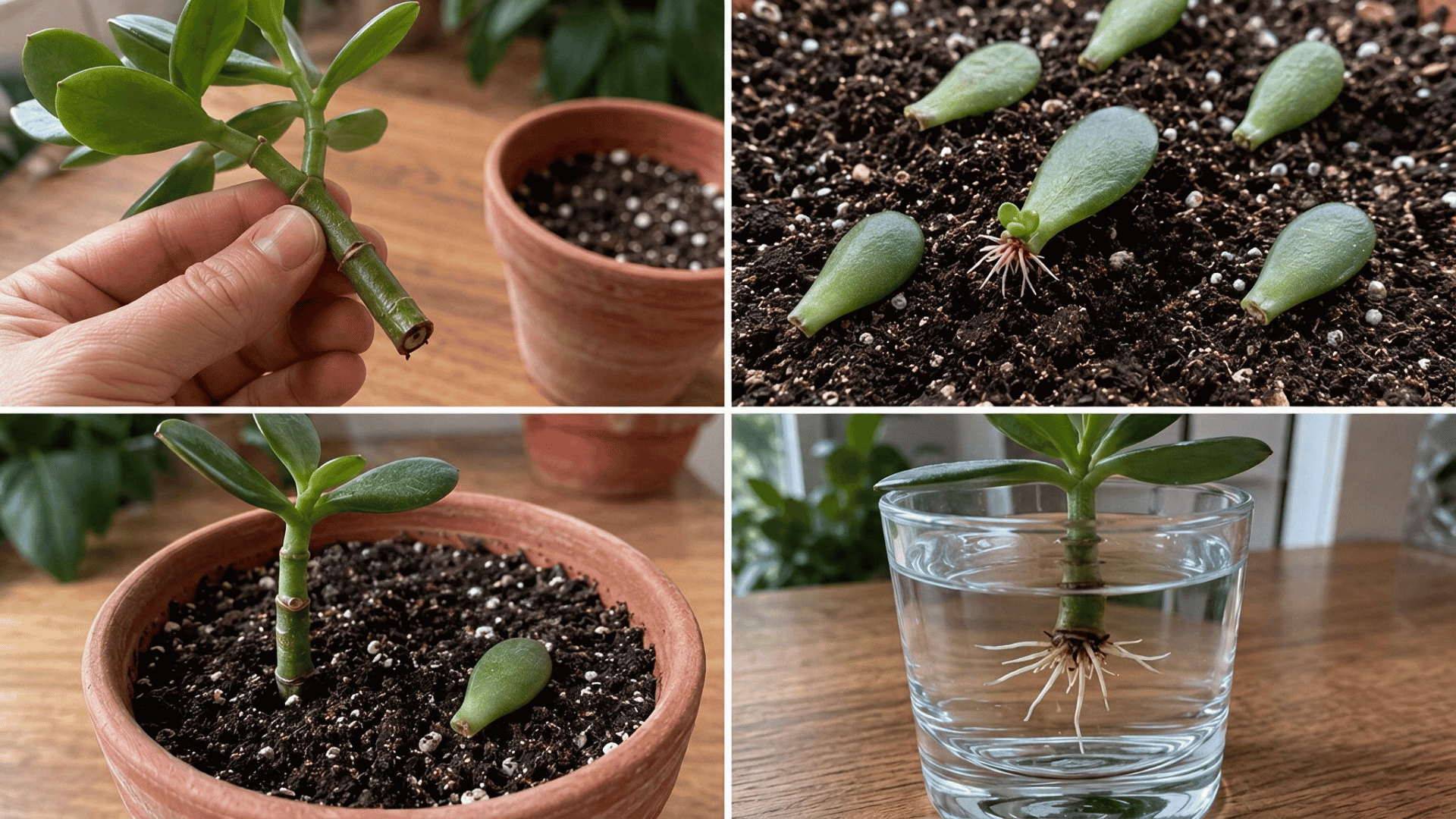

Before jumping into the full process, it helps to know what each method is actually good for, and where it falls short. This is really the first thing to sort out when figuring out how to propagate jade plant cuttings successfully.
If you’re pruning jade plant stems anyway, this is the section that turns those trimmings into new plants instead of compost.
1. Stem Cuttings
The most forgiving method for beginners. A stem cutting already carries stored energy and multiple growth points, giving it a head start over a single leaf.
It roots faster, recovers from mistakes better, and builds visible height sooner than any other method.
- Take a cutting between 3 and 5 inches long with a couple of leaves and one or two bare nodes.
- Let the cut end callus for 1 to 2 days before planting to reduce the risk of rot.
2. Leaf Cuttings
Useful when stem material isn’t available, though slower and less predictable. The leaf acts as a temporary food source while a new plantlet establishes from the base.
Not every leaf will root, so pulling a few extras gives you better odds without much extra effort.
- Use a whole, healthy leaf with the base fully intact – a torn base rarely roots successfully.
- Let the end dry completely before it touches soil, then wait for a small plantlet to appear near the base.
3. Rooting In Soil
The most direct route from cutting to established plant. Roots develop in the same mix they’ll grow in long-term, which skips the transplant step that can stress tender new growth.
It’s also the most practical option when propagating several cuttings at once.
- Use a fast-draining succulent mix and keep it barely moist, never soaked.
- Place stem cuttings in the mix; rest leaf cuttings on top, with the callused end just touching the surface.
4. Rooting In Water
A good option for monitoring root development before committing to soil. It works best with stem cuttings, where a node stays submerged while the leaves remain completely dry above the waterline.
The clear container lets you check progress without disturbing the cutting.
- Change the water every few days to prevent buildup and keep conditions clean.
- Once roots reach 1 to 2 inches, move the cutting into potting mix promptly.
Tools and Materials for Jade Plant Propagation
Jade propagation is refreshingly low-tech. The real job of your supplies is to keep each cut clean and keep water from pooling around it.
|
Tool or Material |
What It’s Used For | Notes |
|---|---|---|
| Clean pruning shears or sharp knife | Taking stem cuttings | Wipe the blade with rubbing alcohol before cutting |
| Healthy jade plant | Source of leaves or stems |
Avoid soft, black, yellow, or damaged tissue |
| Small pot with drainage holes | Rooting cuttings in soil | A smaller pot lowers the chance of soil staying wet too long |
| Succulent or cactus potting mix | Rooting medium | Add perlite or pumice if the mix holds too much water |
|
Small jar or glass |
Rooting stems in water | Keep leaves above the water line |
|
Clean water |
Water propagation | Room-temperature water works well |
|
Tray or paper towel |
Drying cuttings | Use it while the cut end forms a callus |
|
Plant label |
Tracking dates | Note when the cutting was taken and planted |
Skip the fancy propagation kits. Clean tools and good drainage do more work than any specialty product on this list.
How to Propagate Jade Plant Step-by-Step
This is the part that turns a cutting from “trimmed stem” into a “rooted plant.” The steps below cover stem and leaf cuttings, with soil and water options built in where they apply.
Step 1: Choose a Healthy Parent Plant

Start with firm, green growth: no rot, no pests, no serious damage. When pruning a jade plant, set aside the thickest, healthiest stems for this purpose.
For a stem cutting, look for firm leaves, no black or mushy spots, and about 3 to 5 inches of growth with one or two nodes. For leaf propagation, pick a full leaf with its base completely intact.
Step 2: Take the Cutting Correctly

Wipe your tool with rubbing alcohol before cutting – a clean cut heals faster and resists infection, while a crushed stem invites rot.
Slice just below a node and strip the lowest leaf or two. For a leaf, twist gently until the base releases whole.
Tip: If a leaf’s base tears during removal, grab a different leaf. A torn base rarely produces a new plantlet.
Step 3: Let the Cutting Form a Callus

Most people skip this step – it’s usually why cuttings rot instead of rooting. Set the cutting on a dry tray out of harsh sun and wait until the cut surface feels fully dry.
Leaf cuttings callus in 1 to 3 days; stem cuttings take 2 to 7 days depending on thickness.
Tip: Judge readiness by the cut surface itself, not the calendar. Thicker stems simply take longer.
Step 4: Root the Cutting in Soil

Fill a pot with dry or barely damp succulent mix, then insert the callused stem about 1 to 2 inches deep. For a leaf, rest it on the surface with the callused end touching the mix.
Keep the pot in bright, indirect light, and water lightly only after the mix has dried out.
Step 5: Care for the Cutting While Roots Form

New cuttings need patience far more than attention. Give bright, indirect light, keep them away from cold drafts, and hold off on fertilizer until new growth appears.
Let the soil dry out between light waterings, and watch for soft tissue, black spots, or an off smell, all signs of rot.
Tip: Don’t tug the cutting out of the soil to check for roots. Gentle resistance or new growth after a few weeks is a safer signal.
Step 6: Move the Rooted Cutting to Its Pot

Once the cutting holds several roots and feels firmly anchored, choose a pot only slightly larger than the root area and set it at the same depth it rooted at.
Wait a few days before the next watering, then increase sun exposure gradually as the plant settles in.
How to Care for a Jade Plant After Propagation
Once a cutting is potted and settled, care shifts from rooting mode to regular jade plant maintenance, with far less hand-holding needed.
- Light: Bright, indirect light works best, though established plants can handle a few hours of gentle direct sun.
- Rotation: Turn the pot now and then so growth doesn’t lean to one side.
- Watering: Water only once the soil has fully dried out, then water deeply. Overwatering stays the biggest risk, even after roots are established.
- Fertilizer: Skip it for the first few months, then feed lightly during spring and summer.
- Repotting: Repot every couple of years, or once roots start crowding the container.
How Long Does It Take for a Jade Cutting to Root?
Most jade cuttings root within 2 to 6 weeks, depending on the method, the season, and the cutting itself.
Stem cuttings root fastest, since they carry stored energy and multiple growth points. Leaf cuttings take longer, since they have to grow an entirely new plantlet from scratch.
Soil and water rooting move at similar speeds, though water lets you see progress as it happens.
Warmth and bright light also speed things up, so cuttings started in spring or summer tend to root faster than winter ones.
Mistakes to Avoid When Propagating Jade Plants
Most failed cuttings trace back to one of these habits, not to some rare disease. Damage from careless pruning can carry over into propagation too, so clean technique matters at every stage.
- Planting a wet cutting too soon: let the wound callus over first.
- Using heavy potting soil: dense mix holds water far too long.
- Watering too often: jade already stores water in its leaves and stems.
- Burying a leaf too deeply: most of it should stay above the soil.
- Exposing cuttings to harsh sun: direct light can scorch a cutting before roots ever form.
- Using dirty cutting tools: bacteria and fungal spores travel straight into the wound.
- Fertilizing before rooting: there’s nothing for it to feed yet.
- Moving the cutting repeatedly: new roots don’t like being disturbed.
If a cutting struggles, fix one variable at a time. Changing light, soil, and watering all at once makes it harder to know what actually worked.
Final Take
Once you’ve tried a few methods, you’ll likely land on a favorite. For me, stem cuttings in soil have the best odds with the least fuss. Leaf cuttings are worth the wait if you enjoy watching a plantlet form from almost nothing.
Whatever method you choose, the fundamentals stay the same: clean tools, a properly dried callus, fast-draining soil, bright indirect light, and a light hand with watering.
The next time you’re pruning jade plant branches, don’t toss the trimmings. A single parent plant can quietly turn into a small collection, one cutting at a time.
Frequently Asked Questions
Can You Propagate a Jade Plant in Winter?
Yes, though rooting slows down when light levels drop and rooms cool off. Bright indirect light and distance from cold windows or drafts help keep things moving.
Do Jade Plant Cuttings Need Rooting Hormone?
No. Jade cuttings root fine without it. Clean cuts, proper callusing, drainage, and careful watering matter far more than any hormone product.
Will a Variegated Jade Plant Keep Its Color After Propagation?
Stem cuttings hold onto variegation more reliably than leaf cuttings, which often grow back greener.