32 Bathroom Accent Wall Ideas for a Stylish Update
A bathroom does not need a full renovation to feel different. Sometimes, changing one wall can bring in the color, texture, or contrast the space was missing.
As a home design writer, I’ve seen how the right accent wall can completely change the way a bathroom feels without unnecessary work.
From tile and stone to paint, wood, and wallpaper, these bathroom accent wall ideas cover options for different styles, budgets, and moisture levels. Here are ideas to help you choose a wall that works for your space.
Why Add an Accent Wall In the Bathroom?
A bathroom can start to feel a little plain when every wall looks the same. An accent wall gives the room a place for your eyes to land, adding color, texture, or contrast without changing everything else.
The best part is that it does not have to become a huge project. A fresh coat of paint can make a noticeable difference, while tile, stone, or wood details can create a bigger statement if you are ready for a larger update.
The key is choosing a material that fits the space. Tile and stone are better suited for areas that deal with water, while paint and wallpaper can completely change a vanity wall or powder room with much less effort.
Bathroom Accent Wall Ideas for Any Home
Not every accent wall idea works in every bathroom. Some need a professional; some cost a sample pot of paint. Pick what fits the wall, the room, and what you’re actually willing to spend.
1. Vertical Subway Tile Accent Wall

Flip subway tile vertical, and it stops being basic. The grout lines draw the eye up, making low ceilings feel taller and narrow bathrooms less cramped, with zero structural work.
- Best for: Small bathrooms, shower enclosures, and vanity walls
- Tile size: Narrow formats (2×8 or 2×10) push the height illusion further than standard 3×6
- Grout: Dark grout goes graphic; white keeps it classic
- Finish: Matte over glossy in tight spaces; less reflective, softer feel
2. Floor-to-Ceiling Marble Accent Wall
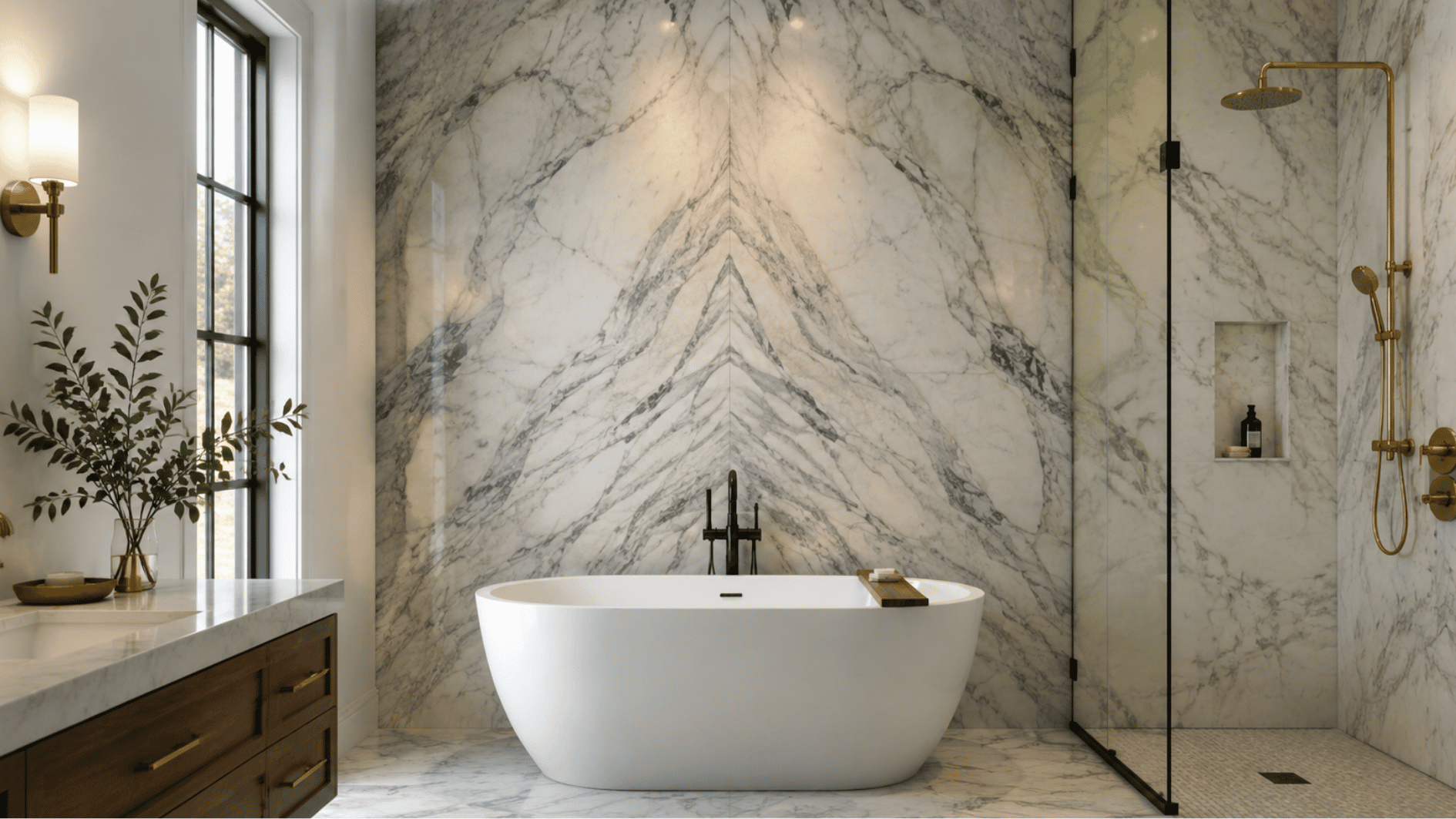
Floor-to-ceiling marble turns a bathroom into a room people remember. The trick is uninterrupted veining; when it runs from floor to ceiling without breaks, the wall feels seamless, not tiled.
- Best for: Freestanding tubs, wet room showers, and master bathrooms
- Material: Marble-look porcelain handles moisture better and costs significantly less
- Pattern: Bookmatch the veining for a high-end, intentional finish
- Fixtures: Matte black or brushed gold let the stone stay the focal point
3. Geometric Tile Accent Wall

One patterned wall- hexagons, zellige, chevron- can carry an entire bathroom’s personality. The rule: one statement wall, everything else quiet. Two competing patterns cancel each other out.
- Best for: Modern and contemporary bathrooms, vanity feature walls
- Low-key option: Single-color hexagon adds texture without pattern complexity
- Vintage feel: Penny tile reads softer than sharp geometric shapes
- Scale: Smaller formats work better in tight spaces; the pattern needs room to land
4. Dark Painted Accent Wall

Most people default to the lightest white they can find and wonder why the bathroom still feels flat. Dark paint- navy, charcoal, forest green- reads as cocooning in a small space, not heavy.
- Best for: Vanity walls, behind-toilet walls, and powder rooms
- Paint type: Use moisture-resistant formulas to prevent peeling
- Lighting: A large mirror opposite bounces light back and opens the room
- Finish: Matte hides imperfections better than eggshell or satin
5. Wood Slat Accent Wall

Bathrooms rarely get warmth; that’s exactly why wood slats work so well in them. Against tile and chrome, a wood wall feels grounding in a way most materials can’t pull off.
- Best for: Vanity walls and dry decorative zones
- Material: PVC wood-look planks mimic the look with zero moisture risk
- Orientation: Vertical slats add height; horizontal feels heavier and wider
- Pairing: Concrete, white tile, or matte black fixtures keep the feel contemporary
6. Textured Plaster Accent Wall

Plaster shifts with light, subtle in the morning, quietly rich at night. It’s the accent wall for people who think they don’t like accent walls. Interesting enough to notice, calm enough to live with.
- Best for: Spa-inspired, minimalist, and earthy bathroom styles
- Wet zones: Use water-resistant paints that can handle splashing near showers
- DIY option: Limewash is the most beginner-friendly with a soft, organic result
- Pairing: Matte fixtures and warm lighting bring out the depth
7. Terrazzo Tile Accent Wall

Terrazzo creates texture without a strong directional pattern, which makes it forgiving in awkward layouts. It doesn’t demand attention; it earns it slowly and tends to look better the longer it’s in the room.
- Best for: Powder rooms, modern bathrooms, and vanity feature walls
- Format: Pre-made tiles are far more accessible than poured in-place terrazzo
- Color: Runs from quiet neutrals to saturated, punchy combinations
- Fixtures: Works with both chrome and brass depending on the colorway
8. Black Matte Tile Accent Wall

Matte black tile is committed. It doesn’t hedge. Keep everything around it light; white fixtures, large mirror, strong lighting, and it becomes the best thing in the room. Neglect that and it reads as a dark corner.
- Best for: Contemporary, industrial, and minimalist bathrooms
- Finish: Matte only; glossy black shows every water spot instantly
- Grout: Match to tile (charcoal or near-black) to avoid a harsh grid effect
- Tile size: Large-format (40×80 cm+) looks more refined than smaller formats
9. Botanical Wallpaper Accent Wall

Wallpaper works in bathrooms, just not everywhere. Low-moisture walls only: behind the toilet, far from the shower, or in a powder room. The right product is vinyl or bathroom-rated wallpaper.
- Best for: Powder rooms and vanity walls far from shower spray
- Print scale: Large tropical prints work well even in small rooms
- Renter option: Peel-and-stick gives the same look with zero commitment
- Cohesion: Pull one color from the print into a towel or mat to tie the room
10. Fluted Panel Accent Wall

Vertical grooves, no color, no pattern, just line and shadow doing quiet work. Behind a floating vanity, the horizontal counter cutting across the vertical panel creates contrast that looks deliberately designed.
- Best for: Vanity feature walls and modern bathroom layouts
- Material: PVC handles humidity without issue; MDF needs sealing first
- Mirror: A round mirror softens the strong vertical geometry
- Color: Neutral tones only; the texture is the statement, not the shade
11. Natural Stone Accent Wall

Stone has depth that manufactured materials spend a lot of effort trying to imitate. Stacked stone changes throughout the day, catches morning light differently than evening light, which makes it one of the few wall materials worth paying attention to.
- Best for: Shower walls, spa-style bathrooms, and high-impact feature walls
- Maintenance: Must be sealed on install and re-sealed periodically
- Travertine: Needs a filled finish in wet areas due to natural pitting
- Pairing: Warm lighting and wood tones draw out the texture
12. Built-In Niche Accent Wall

Storage that looks designed. Tile the niche interior in a contrasting finish, add an LED strip, and a practical shelf becomes the focal point of the wall, in the shower or on a dry wall opposite the vanity.
- Best for: Shower walls, opposite-vanity walls, and storage-light bathrooms
- Interior tile: Contrasting color or finish makes the niche read as intentional
- Lighting: LED strip inside a shower niche adds function and real drama
- Styling: Two or three objects only; restraint makes it look curated
13. Micro-Mosaic Tile Accent Wall

Micro-mosaic works because from a distance it reads as a solid color or gentle gradient, but up close it reveals hundreds of tiny tiles doing the work. It rewards a second look, which is rare in a bathroom.
- Best for: Vanity walls, shower niches, and small powder rooms
- Tile size: 1×1 or smaller for maximum texture; anything larger loses the mosaic effect
- Grout: Matching grout keeps the color reading as one continuous surface
- Finish: Glossy suits mosaic better than matte; it’s built to catch light
14. Concrete-Look Panel Accent Wall

Raw concrete is heavy to install and harder to keep dry; concrete-look panels give the same industrial flatness without the structural cost or the sealing headaches.
- Best for: Modern and industrial bathrooms, shower surrounds
- Material: Large-format porcelain or fiber-cement panels, not poured concrete
- Seams: Minimal-seam installation keeps the monolithic look intact
- Pairing: Black fixtures and warm wood accessories soften the coldness
15. Scalloped Tile Accent Wall

Fish-scale tile brings a soft, almost architectural rhythm to a wall without introducing color or busy pattern. The repetition is the whole point.
- Best for: Shower walls, vanity backsplashes, feature niches
- Tile size: Small to medium scallops read as texture; oversized scallops read as pattern
- Color: Monochrome keeps it timeless; two-tone makes it a focal statement
- Grout: Slim grout lines keep the scalloped edges crisp
16. Smoked Mirror Accent Wall

Mirror isn’t just for vanities. A full smoked or antiqued mirror wall adds depth and light without brightness, and it makes a small bathroom feel like it extends past its actual walls.
- Best for: Powder rooms and windowless bathrooms needing more light
- Material: Antiqued or smoked glass panels, not clear mirror, to avoid a clinical look
- Installation: Panel seams should align with existing tile grid or trim lines
- Lighting: Sconces mounted directly on the mirror amplify the effect
17. Reclaimed Brick Accent Wall

Exposed brick doesn’t usually belong in a bathroom, which is exactly why it stands out when it’s done right. It brings age and imperfection into a room that’s otherwise all hard, new surfaces.
- Best for: Loft-style, industrial, and vintage bathrooms
- Material: Thin brick veneer avoids the weight and moisture issues of full brick
- Sealing: A breathable masonry sealer is essential near any wet zone
- Pairing: Black hardware and simple white fixtures let the texture lead
18. Color-Blocked Paint Accent Wall

No tile, no texture, just a hard-edged block of contrasting color on part of a wall. It’s the lowest-cost, most reversible way to add a focal point.
- Best for: Rental bathrooms, powder rooms, budget refreshes
- Placement: Block behind the mirror or vanity, not the full wall, for intentionality
- Paint type: Moisture-resistant satin or semi-gloss in wet-adjacent zones
- Line work: Painter’s tape gives the cleanest hard edge; freehand reads sloppy
19. Handmade Zellige-Style Accent Wall

The irregular surface and slight color variation in zellige-style tile catch light differently than machine-made tile, which is why it looks alive instead of printed.
- Best for: Vanity walls, shower surrounds, spa-style bathrooms
- Color: Single, saturated color lets the tile’s texture do the talking
- Grout: Thin grout lines in a matching tone preserve the handmade look
- Layout: Slight irregularity in tile placement is intentional, not a flaw
20. Arched Niche Accent Wall

An arch softens a bathroom that’s otherwise all straight lines and right angles. Framing a mirror, tub, or shower niche in an arch instantly makes the wall feel designed rather than default.
- Best for: Freestanding tubs, vanity mirrors, shower entries
- Construction: Drywall arch or curved tile trim, depending on budget
- Tile: Curved tile trim pieces avoid visible cut edges around the arch
- Pairing: Symmetrical lighting on either side reinforces the shape
21. Ombre Tile Accent Wall

A gradient that shifts from dark to light (or one color to another) up a wall adds movement without needing a pattern. It’s subtle until you notice it, then it’s the only thing you notice.
- Best for: Shower walls, floor-to-ceiling feature walls
- Tile size: Small-format tile blends gradient transitions more smoothly
- Direction: Dark-to-light bottom-to-top makes a room feel taller
- Grout: Match grout tone to the nearest tile row to avoid a stepped look
22. Corrugated Metal Accent Wall

Corrugated metal panels bring an unexpected industrial edge, and the ridges catch light in a way flat surfaces can’t, adding texture without any pattern or color.
- Best for: Industrial, modern farmhouse, and powder room feature walls
- Material: Galvanized or powder-coated steel resists rust in humid rooms
- Orientation: Vertical ridges elongate the wall; horizontal widens it
- Pairing: Warm wood vanity or brass fixtures offset the cold material
23. Chevron Wood Accent Wall

Chevron flooring gets most of the attention, but the same angled pattern on a wall brings movement and a sense of craftsmanship that flat paneling doesn’t.
- Best for: Vanity walls, dry accent zones away from direct water
- Material: PVC or sealed engineered wood for humidity resistance
- Angle: 45-degree cuts read more dynamic than 90-degree herringbone
- Finish: Matte sealant keeps the grain visible without excess shine
24. Pebble Tile Accent Wall

Pebble tile brings the outdoors in, and the uneven surface creates shadow and texture that flat tile simply can’t replicate.
- Best for: Shower floors extending up the wall, spa-style bathrooms
- Material: Sealed natural stone pebbles on a mesh backing
- Grout: Deep grout fill is needed to lock pebbles in place securely
- Maintenance: Reseal annually to prevent staining in high-moisture areas
25. Half-Wall Tile with Painted Top Accent Wall

Splitting a wall between tile below and paint above is a practical trick that reads as a design choice, not a budget compromise, when the transition line is treated deliberately.
- Best for: Vanity walls, powder rooms, budget-conscious renovations
- Transition: A trim strip or picture rail at the tile line looks intentional
- Tile height: Chair-rail height (36-42 inches) reads classic; taller feels modern
- Color: Paint above should echo a tone already present in the tile
26. Backlit Onyx Accent Wall

Onyx is translucent, so backlighting it turns a wall into a genuine light source. Few materials in a bathroom can do this, which is why it reads as luxury even in a modest space.
- Best for: High-end vanity walls, statement shower walls
- : Thin-cut onyx slabs or onyx-look porcelain with LED backing
- Installation: Requires a lit cavity behind the slab; plan electrical early
- Fixtures: Keep other finishes simple so the glow stays the focal point
27. Cork Accent Wall

Cork is naturally water-resistant and sound-dampening, and its warm, organic texture is something bathrooms rarely get since most materials in the room are hard and cold.
- Best for: Dry vanity walls, spa-inspired bathrooms
- Material: Sealed cork tile or cork wallpaper, away from direct spray
- Sealing: A water-based sealant adds moisture protection without losing texture
- Pairing: Matte black or brass fixtures keep the palette grounded
28. Large-Format Slab Accent Wall

Fewer grout lines means fewer places for a bathroom to look busy. A single large-format slab reads as one continuous surface, almost like a piece of furniture.
- Best for: Shower walls, floor-to-ceiling vanity backdrops
- Format: Slabs up to 60×120 inches minimize seams significantly
- Installation: Requires professional handling due to weight and size
- Pattern: Bookmatched slabs create a mirrored, high-end veining effect
29. Chalkboard or Slate Paint Accent Wall

An unexpected but functional choice, a chalkboard-finish wall in a powder room adds personality and a bit of interactivity that no static material can offer.
- Best for: Powder rooms, kids’ bathrooms, guest bathrooms
- Paint type: Moisture-tolerant chalkboard paint formulated for humid rooms
- Use: Leave a piece of chalk for guests, or write a rotating quote
- Framing: A simple wood or metal frame keeps it from looking unfinished
30. Basketweave Marble Accent Wall

Basketweave’s interlocking pattern adds dimension through shadow and shape rather than color, so it stays sophisticated instead of busy.
- Best for: Vanity walls, shower floors extending onto the wall
- Material: Marble or marble-look porcelain in basketweave mosaic sheets
- Color: Two-tone (white and gray) emphasizes the woven effect
- Grout: Light grout keeps the pattern crisp and legible
31. Vertical Wood and Tile Combo Accent Wall

Splitting a wall vertically between wood slats and tile creates two distinct textures in one sightline, which reads as curated rather than mismatched when the proportions are right.
- Best for: Vanity walls, wide bathroom layouts with room to divide
- Proportion: A two-thirds to one-third split avoids a too-even, busy look
- Materials: Waterproof PVC wood-look paired with matte porcelain tile
- Transition: A metal trim strip at the seam keeps the line clean
32. Antique Brass Panel Accent Wall

Aged or hammered brass panels bring warmth and reflectivity without the coldness of chrome or steel, and the patina only improves with time instead of needing to be kept pristine.
- Best for: Powder rooms, vanity walls in warm-toned bathrooms
- Material: Hammered or antiqued brass sheet, sealed against moisture
- Finish: A visible patina is a feature, not a flaw, in this style
- Pairing: Deep green or terracotta tones make the brass pop
How to Choose the Right Material for a Bathroom Accent Wall
The same idea, say, a wood slat wall, works beautifully in one bathroom and fails completely in another because the wall’s placement and daily moisture exposure make all the difference.
| Material | Best For | Things to Consider |
|---|---|---|
| Tile | Showers, tubs, and high-moisture areas | Durable, easy to clean, wide format and color range |
| Wallpaper | Powder rooms and dry walls | Vinyl or bathroom-rated only; keep away from direct moisture |
| Wood panels | Vanity walls and dry decorative zones | PVC or sealed MDF, raw wood won’t last in humidity |
| Stone | High-impact feature and shower walls | Heavier installation; must be sealed and re-sealed |
| Plaster | Spa-inspired and minimalist bathrooms | Tadelakt handles wet zones; limewash suits dry walls |
| Fluted panels | Modern vanity feature walls | PVC handles humidity; MDF needs sealing before install |
How to Plan a Bathroom Accent Wall Makeover
Most people start with Pinterest, fall for a material, buy it, and realize too late it clashes with their fixtures or can’t handle the humidity. The idea was right. The order was wrong.
A bathroom accent wall is easy to install and hard to undo, so the planning matters more than the material. Here are five steps to get it right the first time.
- Pick the wall: Go for the wall opposite the door or behind the vanity. That’s where eyes land first.
- Check moisture: Wet zone gets tile or sealed stone. Dry wall opens up to wood, plaster, wallpaper, or paint.
- Match fixtures first: Note the metal finish and existing tile tone before picking anything. The accent wall works with the room, not against it.
- Set a budget: Paint under $50, wallpaper $100–$400, tile and stone higher. Know the ceiling before you start.
- Look at real examples: Houzz and Reddit r/Bathrooms show how materials look in finished rooms, not just product photos.
Real Experiences with Bathroom Accent Walls
People share their real bathroom accent wall experiences and updates, including tile, stone, and panel ideas that changed their spaces.
“Built a niche in my shower wall and tiled the inside in black penny tile. The contrast against the white surrounding tile is everything.” – NicheAndNailed, Houzz
“Put stacked slate on the wall behind my shower. It looks like a luxury spa. The lighting makes it look different at every hour of the day.” – StoneAndSteam, Houzz
“White fluted panels on my vanity wall, paired with a warm LED mirror. Completely transformed the room for about $300 total.” – DIYBathroomReno, Houzz
“Full black matte tile behind my freestanding tub. It looks incredibly dramatic in the best possible way.” – ModernBathroomBuild, Reddit
“Used marble-look porcelain in my master bath floor to ceiling and people literally think I spent double what I did.” RenovatingOnARealBudget, Reddit
Final Thoughts
One wall. That’s all it takes to make a bathroom feel like it was actually designed, not just finished. The material matters, the wall matters, the planning matters, but none of it has to be complicated.
I’ve seen a $30 pot of paint do more for a bathroom than a full retile. I’ve also seen a badly chosen wallpaper peel off within six months. The difference is always in the decision, not the budget.
Pick the right wall, match it to the room, and commit. The bathroom you’ve been ignoring might just become your favorite room in the house.
Frequently Asked Questions
How Much Does It Cost to Add a Bathroom Accent Wall?
The cost depends on the material and wall size. Paint is the most affordable, while tile, stone, and custom finishes usually require a larger budget.
Can You Add a Bathroom Accent Wall Without a Full Remodel?
Yes. Simple updates like paint, wallpaper, or panels can refresh the bathroom without replacing existing fixtures or finishes.
How Do You Make a Bathroom Accent Wall Stand Out?
Use lighting, contrasting colors, and small matching details like fixtures or accessories to highlight the wall without making the space feel crowded.
Are Bathroom Accent Walls Still Popular?
Yes. Accent walls remain popular because they add personality and style while allowing people to update a bathroom without changing the entire space.