

18 Types of Wood Used in Furniture
You’re shopping for furniture, and the salesperson asks what wood you prefer.
You freeze. Oak, maple, and pine all sound the same. You worry about choosing wrong and wasting money on furniture that won’t last.
The truth is, choosing wood is simple once you know the basics. Each type has strengths that match different needs and budgets.
This blog covers types of wood for furniture, so you can pick furniture that works for your home and wallet.
Main Categories of Wood Used in Furniture
Before exploring specific wood types, it’s helpful to understand how woods are classified. Furniture makers typically use two main categories: hardwoods and softwoods.
Hardwoods come from deciduous trees that lose their leaves annually.
These woods are typically denser and more durable. Common hardwoods include oak, maple, cherry, and walnut.
Softwoods come from coniferous trees with needles and cones.
Despite the name, some softwoods can be quite durable. Pine, cedar, and fir fall into this category.
Hardwoods Used for Furniture
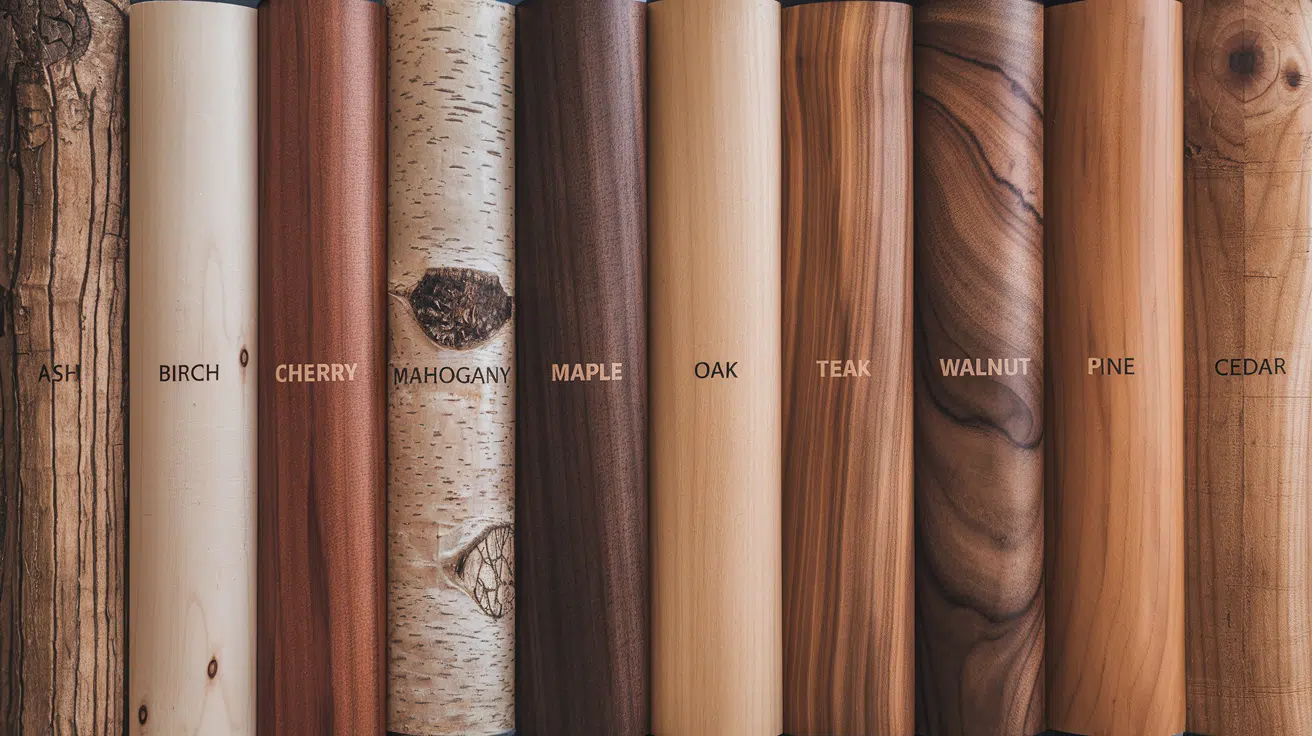
Hardwoods come from deciduous trees and offer superior durability, rich grain patterns, and long-lasting beauty, perfect for high-use furniture that stands the test of time.
1. Oak
Oak is the most popular hardwood for furniture. It combines strength, durability, and attractive grain patterns at reasonable prices.
- Red Oak: has a pinkish tone with prominent grain. It’s slightly softer than white oak but more affordable. Works well for cabinets, tables, and traditional furniture.
- White Oak: has a neutral tan color and a tighter grain. It’s naturally water-resistant, making it perfect for outdoor furniture and moisture-prone areas. More expensive but more durable.
Best for: Dining tables, cabinets, mission-style furniture, farmhouse pieces
2. Maple
Maple is one of the hardest domestic woods available. It resists dents and scratches exceptionally well.
- Hard Maple(sugar maple): is extremely hard with a light, creamy color. The fine grain creates a clean look perfect for modern furniture. Takes paint beautifully.
- Soft Maple: is 25% softer but still quite durable. It has a nearly identical appearance to hard maple but is more affordable.
Best for: Kitchen cabinets, contemporary furniture, painted pieces, butcher blocks
3. Cherry
Cherry wood is prized for its rich color that deepens over time. It starts light pinkish-brown and darkens to deep reddish-brown with age and light exposure.
The grain is fine and smooth. Cherry is moderately hard, softer than oak or maple but still durable. The wood is very stable and resists warping.
Best for: Fine dining sets, bedroom furniture, traditional pieces, heirloom furniture
4. Walnut
Walnut is a premium hardwood with a deep chocolate-brown color. The natural color is so beautiful that it rarely needs staining.
The grain is usually straight with occasional beautiful swirls. Walnut is moderately hard and very stable, resisting warping and shrinking.
Best for: High-end furniture, statement pieces, mid-century modern designs, luxury items
5. Mahogany
Mahogany features a reddish-brown color and straight, even grain. This wood has been used for fine furniture for centuries.
True mahogany is rare and expensive. Many furniture makers now use African mahogany or similar species. The wood is very stable and resists swelling and shrinking.
Best for: Traditional furniture, antique reproductions, formal pieces
6. Ash
Ash offers excellent strength and shock resistance. It has a light color similar to oak with prominent grain patterns.
The wood is strong yet flexible, making it ideal for bent wood furniture and pieces that take heavy use.
Best for: Chairs, bentwood furniture, sports equipment, tool handles
7. Hickory
Hickory is the hardest domestic hardwood. It’s extremely strong with dramatic grain patterns and color variation.
The wood ranges from white sapwood to brown heartwood, often in the same board. This creates rustic character.
Best for: Rustic furniture, high-impact pieces, casual furniture
8. Birch
Birch has a smooth, even grain with a light color. It’s moderately hard and takes stains well, often used as a less expensive alternative to maple.
Yellow birch is harder and used for furniture frames and structural components.
Best for: Budget-friendly furniture, painted pieces, cabinet interiors
Softwoods Used for Furniture

Softwoods come from coniferous trees and provide lightweight, affordable options with natural warmth.
Ideal for bedrooms, rustic designs, and budget-friendly furniture that still delivers quality.
9. Pine
Pine ranks as the most widely used softwood for furniture. Its light color, visible grain patterns, and workability make it ideal for various styles.
Types of pine used in furniture:
- Eastern White Pine: Softest variety with minimal grain
- Yellow Pine: Harder and more durable with pronounced grain
- Ponderosa Pine: Medium hardness with uniform texture
Pine furniture accepts stains well and develops a warm patina over time. It works beautifully for rustic, farmhouse, and traditional designs.
10. Cedar
Cedar brings natural insect-repelling properties and aromatic qualities to furniture. Red cedar and white cedar are the primary varieties used.
This wood resists moisture and decay, making it perfect for outdoor furniture, closet linings, and storage chests.
The distinctive scent adds character while protecting stored fabrics from moths and other pests.
11. Fir
Douglas fir offers an excellent strength-to-weight ratio among softwoods. Its straight grain and moderate hardness suit structural furniture pieces.
Fir’s reddish-brown heartwood contrasts attractively with lighter sapwood. This wood holds nails and screws securely, making it reliable for construction.
12. Spruce
Spruce provides uniform texture and light coloring. It’s fine; straight grain allows for smooth finishes.
While not as strong as fir, spruce works well for furniture frames, drawer sides, and hidden structural components. Its affordability makes it common in budget-friendly furniture lines.
13. Redwood
California redwood delivers natural beauty with exceptional durability. The rich, reddish-brown color needs no stain to look striking.
Redwood resists rot, insects, and weathering better than most softwoods.
These qualities make it a premium material for outdoor furniture that lasts decades.
Engineered and Manufactured Woods

Engineered woods combine wood fibers with adhesives to create stable, affordable materials that resist warping and cost less than solid wood.
14. Plywood
Plywood layers are thin wood veneers with alternating grain directions. This cross-grain construction creates exceptional strength and stability.
It resists warping better than solid wood and stays strong in both directions.
Cabinet-grade plywood with hardwood faces creates attractive visible surfaces for furniture.
15. Medium-Density Fiberboard (MDF)
MDF combines wood fibers with resin under heat and pressure. The result is an extremely smooth, dense board without grain.
This material excels for painted furniture, its smooth surface needs minimal prep. MDF takes router bits cleanly for decorative edges. However, it’s heavy and vulnerable to moisture damage.
16. Particle Board
Particle board uses wood chips and sawdust bonded with resin. It costs less than MDF but offers lower strength.
This material works for furniture backs, drawer bottoms, and hidden components. Quality varies significantly between manufacturers. Budget furniture often uses particle board extensively.
17. Oriented Strand Board (OSB)
OSB layers wood strands in specific orientations for strength. The visible strand pattern gives a distinctive appearance.
While common in construction, OSB rarely appears in furniture. Some industrial designs incorporate OSB for textured looks. It resists moisture better than particle board.
18. Hardboard
Hardboard compresses wood fibers into thin, dense sheets. Tempered hardboard is treated with oil for added strength.
Furniture makers use it for drawer bottoms, cabinet backs, and dust panels. It costs less than plywood for these hidden applications.
How to Choose the Right Wood for Your Furniture
Buying furniture feels overwhelming with so many wood options. Sales staff use confusing terms while you worry about mistakes.
- Set Your Budget: Hardwoods like oak cost $1,500-3,000+ for tables. Pine runs $800-1,500. Plywood costs $600-1,200. MDF ranges from $300 to $800.
- Match Wood to Room: Dining rooms need hardwoods for heavy use. Bedrooms allow softer pine. Bathrooms need moisture-resistant materials. Offices need stable plywood.
- Consider Your Lifestyle: Kids and pets scratch soft woods—choose harder oak. Frequent movers need lighter materials.
- Know Wood Hardness: Hickory: 1,820 (hardest). Maple: 1,450. Oak: 1,290. Walnut: 1,010. Pine: 690 (softest). Harder woods resist damage better.
- Match Wood to Style: Traditional suits oak and cherry. Modern works with walnut and maple. Rustic needs pine and cedar. Scandinavians use ash and birch. Industrial features reclaimed oak.
- Check Maintenance: Sealed maple needs dusting. Hardwoods need periodic polishing. Unfinished wood needs regular treatment.
- Inspect Construction: Check dovetail joints and smooth finishes. Test metal hardware. Construction quality matters most.
Solid Wood vs Engineered Wood Furniture
| Feature | Solid Wood | Engineered Wood |
|---|---|---|
| Cost | $2,000-4,000 (dining table) | $800-1,500 (dining table) |
| Lifespan | 50+ years | 15-25 years |
| Weight | Heavy (200+ lbs dresser) | Light (100-150 lbs dresser) |
| Refinishing | Multiple times | Limited/None |
| Moisture | Handles well when sealed | Poor (MDF/particle board) |
| Stability | Expands/contracts | Dimensionally stable |
| Repairs | Easy to fix | Difficult to repair |
| Appearance | Natural grain, unique | Consistent, veneer looks similar |
| Environmental | Slow-growing trees | Uses waste, fast-growing trees |
Conclusion
Choosing types of wood for furniture isn’t about finding the “best”; it’s about matching your needs.
Hardwoods offer durability but cost more. Softwoods provide affordability. Engineered woods deliver budget value.
Focus on construction quality over wood type. Well-made pine outlasts poorly made oak.
Start with your budget and lifestyle, then inspect carefully. The right choice serves you well for years.


