Why Do Leaves Change Color in Fall? The Science Explained
Every fall, hillsides turn red, orange, and gold almost overnight, and it truly catches people off guard. That shift comes down to plant chemistry, built into every leaf months before the colors show.
Shorter days and cooler autumn air trigger changes that were always waiting to happen.
This article explains why fall leaves change color, what makes some years brighter than others, which trees put on the best show, and where to see the best fall foliage in person.
Why Do Leaves Change Color in Fall?
Leaves change color in fall because trees stop making chlorophyll, the green pigment that powers photosynthesis all summer. As days grow shorter and nights turn cooler, chlorophyll breaks down and fades away.
Once it disappears, yellow and orange pigments that were hidden underneath become visible, and some trees create brand-new red pigments as sugar builds up inside the leaf.
Together, these changes produce the full range of fall color, as the Smithsonian Institution describes.
The Three Pigments Behind Fall Color

Every fall color traces back to one of three pigments already sitting inside the leaf. Here is what each one does and when it takes over.
|
Pigment |
Color It Produces |
What It Does |
|---|---|---|
|
Chlorophyll |
Green |
Powers photosynthesis all summer, then breaks down as daylight fades |
|
Carotenoids |
Yellow and orange |
Present in the leaf year-round, hidden by chlorophyll until it disappears |
|
Anthocyanins |
Red and purple |
Formed fresh in fall when sugar gets trapped inside the leaf |
What Triggers the Color Change
Shrinking daylight sets the whole process in motion, more than falling temperatures do. As nights grow longer after the autumn equinox, trees pick up on that signal and begin shutting down chlorophyll production.
A layer of cells called the abscission layer forms where each leaf meets its branch, slowly cutting off water and nutrients.
According to the U.S. Forest Service, this day length signal stays more consistent from year to year than temperature, which is why the color change follows a fairly predictable calendar even when the weather varies.
Why Do Some Years Have More Vibrant Colors Than Others?
Color intensity changes from year to year because of weather, not chance. Warm, sunny days paired with cool but frost-free nights tend to produce the brightest reds and oranges, since sugar builds up in the leaf during the day and stays trapped once temperatures drop at night.
A dry summer followed by a sudden early frost can cut the season short and mute the display, while a wet growing season followed by a crisp, sunny fall usually delivers the most striking color.
What’s the Fall Foliage Forecast
For 2026, forecasters expect a strong season in several regions. AccuWeather predicts New England and upstate New York will see especially bright color this year, thanks to a wet spring and summer followed by drier, cooler conditions heading into fall.
The Farmers’ Almanac points to the central Appalachians as this year’s standout region, while parts of the Pacific Northwest, Upper Midwest, and southern states may see more muted color due to drought and wildfire stress earlier in the year.
Why Do Trees Bother Changing Color at All?
Color change does more than brighten hillsides for a few weeks. It plays a direct role in how trees survive winter and support the surrounding forest.
-
Saving energy for winter: Before a leaf drops, the tree pulls nutrients back out of it and stores them in its branches and roots.
-
Avoiding storm damage: Shedding leaves means fewer broad surfaces left to catch heavy snow or ice that could snap branches.
-
Feeding the forest floor: Fallen leaves break down into the soil and add nutrients that support the tree and its neighbors the following year.
Deciduous vs. Evergreen Trees
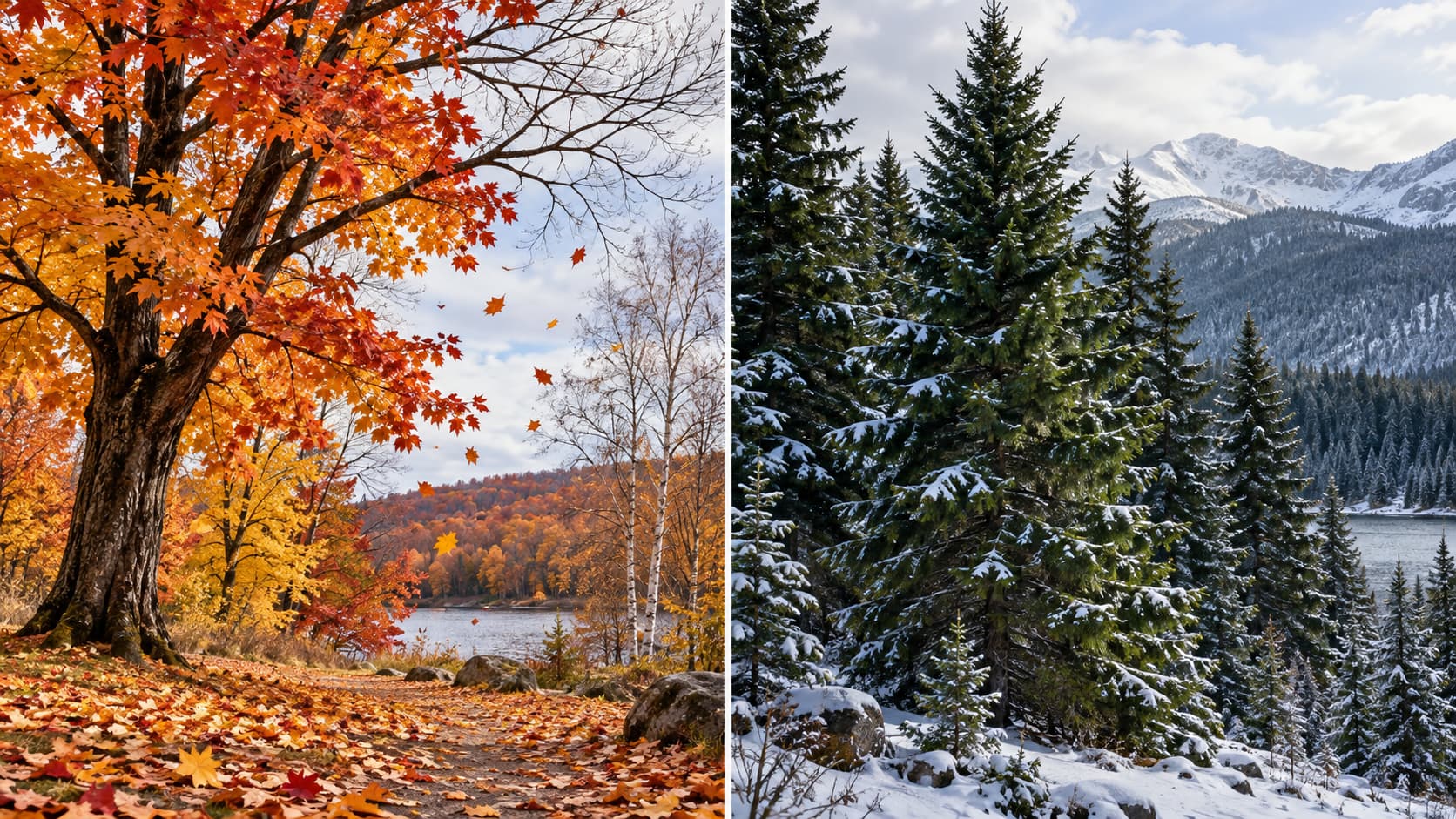
Not every tree loses its leaves in fall, and the difference comes down to how each type is built for winter. Here is a quick side-by-side comparison.
|
Feature |
Deciduous Trees |
Evergreen Trees |
|---|---|---|
|
Leaf type |
Broad, flat leaves |
Needle-like or scale-like leaves |
|
What happens in fall |
Leaves change color and drop |
Foliage stays green through winter |
|
Winter strategy |
Sheds leaves to save energy and avoid storm damage |
A waxy coating and antifreeze-like fluid protect needles from cold |
|
Examples |
Maple, oak, birch, aspen |
Pine, spruce, fir, cedar |
Which Trees Turn Which Colors
Not all trees turn the same shade, and the color alone can often tell you exactly what tree you are looking at. Here is what to expect from a few common ones.
1. Maples

Maples put on one of the most varied displays of any tree family. Sugar maples typically turn orange to red, red maples often go bright scarlet, and black maples shift to a warm golden yellow.
Typical color: orange, red, or gold, depending on the species
2. Oaks

Oaks tend to change later than most other trees and lean toward brown, russet, or deep red rather than bright orange. Their thicker leaves hold onto more tannins, which is part of why the color stays earthy instead of bold.
Typical color: brown, russet, or deep red
3. Aspens and Poplars

Aspens and poplars are usually among the first trees to turn, sometimes as early as August in cooler climates. Their leaves shift to a clean, golden yellow that stands out sharply against dark evergreen backdrops.
Typical color: golden yellow
4. Dogwoods

Dogwood leaves turn a deep, purplish red, often alongside the small red berries the tree produces around the same time. It is one of the more distinct color combinations you will spot outdoors in fall.
Typical color: purplish red
5. Hickories

Hickories change late in the season and turn a rich, golden bronze. Their color tends to hold well even after nearby trees have already dropped their leaves.
Typical color: golden bronze
Top Destinations For Viewing Fall Leaves
Some regions consistently deliver the best fall color in the country, thanks to the right mix of tree variety, elevation, and climate. Here are a few worth planning a trip around this year.
-
New England (Vermont, New Hampshire, Maine): Dense sugar maple forests usually peak in early to mid-October.
-
Great Smoky Mountains National Park: A wide range of elevations stretches the color season across several weeks.
-
Blue Ridge Parkway and the Appalachians: Forecast to have one of the strongest seasons in 2026, according to the Farmers’ Almanac.
-
Upper Midwest (Michigan, Wisconsin, Minnesota): Known for early, bright color thanks to large maple and aspen stands.
-
Colorado and the Rocky Mountains: Famous for hillsides of golden aspens set against dark evergreen forests.
Conclusion
Fall color comes down to plant chemistry, survival, and careful timing working together inside every leaf you see. Chlorophyll fades, hidden pigments show through, and some trees build brand new color as sugar gets trapped inside.
Weather decides how bright each season turns out, and this year’s forecasts point to strong color across New England and the Appalachians.
Next time you walk outside under a red maple or a golden aspen, you will know what is happening above your head.
Frequently Asked Questions
Is it “fall leafs” or “fall leaves”?
The correct plural of leaf is leaves, so fall leaves is the correct spelling. Fall leafs is a common misspelling, not an accepted variation.
What do you call fall leaves?
Fall leaves are also called fall foliage or autumn color, and the popular activity of viewing them is known as leaf peeping.
What are 5 fall colors?
The colors most associated with fall are red, orange, yellow, brown, and deep green or burgundy.
What are three popular fall colors?
Red, orange, and yellow are the three colors people most often connect with fall, and they line up directly with the pigments found in changing leaves.
What colors to avoid in fall?
Bright neon shades and cool pastel tones tend to clash with fall’s warm palette of reds, oranges, and browns.
What two colors go worst together?
Red and green are often named the worst pairing in color design because the two shades can visually clash and are difficult for colorblind viewers to distinguish.