Should You Install a New Roof Before Solar? What to Check First
Solar quotes arrive with a lot of numbers attached. Payback periods, production estimates, financing terms, tax credits.
The number almost nobody puts in front of you is how many years your roof has left.
That omission is expensive, because a solar array and a roof are supposed to last for decades, and if one of them gives out first, the other has to come off to fix it.
The Timing Mismatch Nobody Plans For
Solar arrays are built to generate power for a very long time. Roofs are not all built to last that long, and yours is already partway through its life.
If your roof has eight or ten years left and your panels are designed to produce for far longer, you have not bought a solar system. You have bought a solar system plus a future removal and reinstallation bill.
That second bill is entirely avoidable, and it is the reason experienced contractors inspect the roof before designing anything. Dura-Foam puts roof inspection first in its published process, confirming the roof is ready for solar’s full service life before a system is designed.
How to Judge Whether Your Roof Can Wait
Age is the starting point but not the answer. A roof’s remaining life depends on the material, the installation quality, the amount of sun it takes, and whether water has ever been allowed to sit on it.
Look for the obvious signals first. Cracking, blistering, granule loss, soft spots underfoot, staining on interior ceilings, and any area where water pools after rain and takes more than a day or two to clear.
Then get an independent assessment rather than relying on the solar company’s glance from the driveway. The same care applies here as with any large home project, and the questions to ask before hiring a professional matter more than the quote itself.
If the roof has fewer than ten years of realistic life left, doing the roof first is almost always the cheaper path.
Worth asking about maintenance intervals too, since some systems are designed to be renewed rather than replaced. Dura-Foam states its foam roofs last twenty to thirty years without recoating, and that two recoats across the roof’s life extend that to around forty five years, which changes the arithmetic considerably when you are matching roof life to array life.
Why Penetrations Are the Real Risk
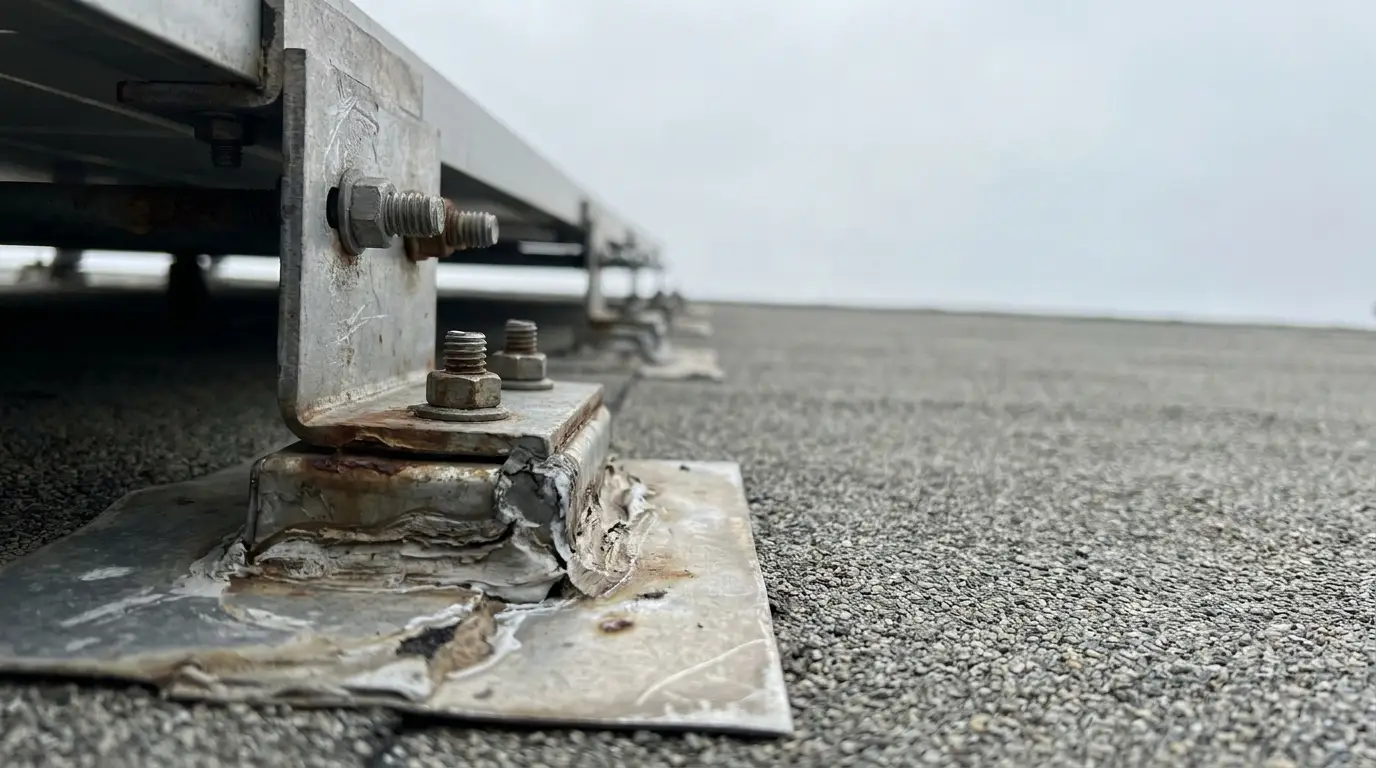
Most rooftop solar is bolted down, which means holes. Each mount is a penetration through the waterproofing layer, and each penetration depends on flashing to keep water out.
Flashing is a detail, and details are where roofs leak. On a conventional membrane or shingle roof, the mount is a foreign object sealed into the surface rather than part of it.
This is where roof type genuinely changes the risk profile. Sprayed polyurethane foam is applied as a single seamless layer, typically around an inch and a half thick, compared with membrane systems that are a fraction of that and held together with seams.
Because the foam adheres aggressively to whatever it covers, it forms a watertight seal around protrusions rather than relying on a flashing detail. Dura-Foam describes this as the self-flashing property of spray foam, and on a roof carrying dozens of mounting points it matters.
Walkability is the other thing worth asking about. Panels need cleaning, inspection and occasional repair, which means people on your roof repeatedly for as long as the array is running.
A rigid surface rated to be walked on tolerates that traffic. A brittle or aging membrane accumulates damage from it, and the damage tends to appear years later as a leak nobody can trace.
The Two Contractor Problem
Here is the scenario that generates the most homeowner complaints. The roofer installed the roof, a different company installed the panels, and now there is a stain on the bedroom ceiling.
The roofer says the leak is at a solar mount. The solar installer says the roof was already compromised. Both are partly right, neither is accountable, and you are the one paying to find out.
Sourcing both from one contractor removes the argument entirely. Dura-Foam makes this explicit, describing single-contractor accountability with no finger-pointing between roofer and installer, and warranty support where one call covers the roof, the solar, the monitoring and the diagnostics.
For anyone in Northern California weighing this up, the best roofing and solar company in the Bay area for your situation will be one that engineers and guarantees both systems rather than subcontracting half the job. Dura-Foam has worked out of Menlo Park since 1981 and holds separate California state licences for roofing and for solar, which is the practical test of whether a company actually does both.
What California Conditions Add
Bay Area roofs take an unusual combination of punishment. Coastal fog keeps surfaces damp, winter rain arrives concentrated, and summer delivers sustained ultraviolet exposure that hardens and cracks aging materials.
Reflective cool roof coatings help on both fronts. They reduce heat absorbed into the house, and solar panels themselves operate more efficiently when they are not sitting above a surface radiating stored heat back at them.
Flat and low slope roofs, common across mid-century Bay Area housing, need particular attention before panels go on. Drainage is already marginal on these roofs, and adding an array creates shade, debris traps and new places for water to sit.
Conclusion
The order of operations is the whole question. Roof first, then solar, unless an honest inspection tells you the roof genuinely has decades left.
Ask for the roof’s remaining life in writing before you sign a solar contract. Ask who is liable if a leak appears at a mounting point, and ask whether one company or two will be answering that call.
Getting those answers up front costs nothing. Getting them wrong costs the price of removing and reinstalling an entire array.
FAQ
1. How old is too old for a roof to take solar panels?
There is no universal number, since material and condition matter more than age alone. The practical test is whether the roof’s remaining life comfortably exceeds the expected service life of the array, and if it does not, reroofing first avoids a removal and reinstallation cost later.
2. Do solar panels damage your roof?
Properly installed panels should not, but the mounting penetrations are the vulnerable point. Problems usually trace to flashing that was installed incorrectly rather than to the panels themselves.
3. Can I install solar on a flat roof?
Yes, and it is common on low slope homes, though drainage and ponding need addressing beforehand. Seamless systems such as sprayed foam handle the mounting penetrations differently from membrane roofs, since the material seals around protrusions rather than depending on separate flashing.
4. Should I use the same company for my roof and my solar?
It removes the liability gap that appears when a leak develops around a solar mount and two contractors disagree about the cause. Companies licensed for both, and offering a single warranty covering the roof and the array, avoid that situation.