
What Is a Prefab Plunge Pool and What Makes It Different From a Traditional Pool?
If you’ve been thinking about adding a pool to your backyard but aren’t sure a full-size one makes sense for your space or budget, a prefab plunge pool might be exactly what you’re looking for. More homeowners are going this route – and once you understand how they’re built and what they actually cost, it’s easy to see why.
What Is a Prefab Pool
Prefab is short for prefabricated, meaning the pool is manufactured off-site in a factory and delivered to your home ready to install. Instead of building everything from scratch in your backyard, you’re getting a structure that already has its shape, finish, and sometimes even plumbing connections sorted before it ever touches your property.
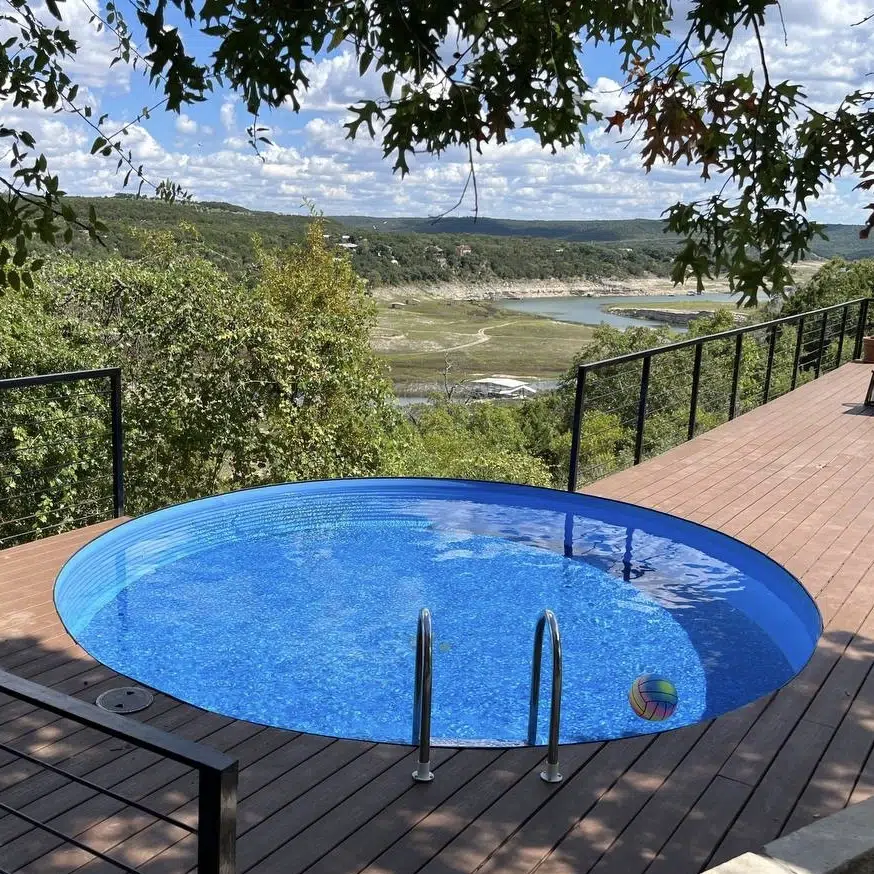
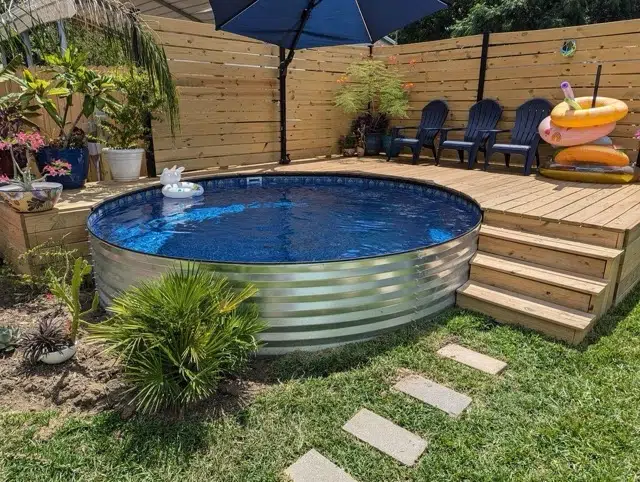
Most prefab plunge pools are made from fiberglass – molded in a single piece and set into a pre-dug hole. Some use a prefabricated steel or polymer frame assembled on-site, with a custom vinyl liner stretched inside. Others, like custom tank pools, take a different approach – using galvanized steel walls paired with a vinyl liner to create a durable, stylish structure that can sit above ground, be partially buried, or recessed completely into your yard. Either way, the core structure is built ahead of time in a controlled environment, not constructed by hand in your yard the way a traditional concrete pool would be. The result is a pool that’s ready to enjoy far sooner – and with far less disruption – than anything built from scratch, which is exactly what makes prefab plunge pools worth considering for most homeowners.
How a Prefab Pool Differs From a Traditional Pool
The biggest differences come down to how it’s built, how long it takes, and how much digging and prep work your yard actually needs.
Build process
A traditional concrete or gunite pool is built entirely on-site – workers pour and shape everything in your backyard over the course of several months. A prefab plunge pool skips most of that. The shell arrives ready to set, plumb, and connect. No curing time, no building from raw materials, and generally fewer surprises once work begins. Tank pools take this a step further – StainlessSwim, for example, assembles the galvanized steel wall system on-site with minimal prep, and since no extensive excavation is required, the whole process is even less disruptive to your yard.
Installation timeline
A fiberglass prefab plunge pool can typically go in within one to two weeks once excavation is done. Concrete pools take three to six months from breaking ground to the first swim. Tank pools, on the other hand, can be ready in as little as two to three days for simpler above-ground setups. If you’re planning around the summer season, that difference is hard to work around.
Site work
Concrete pools can be poured around slopes and tight corners – they conform to your space. A prefab plunge pool comes in a fixed size, so the hole has to match the shell. Tank pools offer a bit more flexibility here – they can be installed above ground, partially buried, or fully recessed, depending on your yard and preferences. That said, the compact footprint makes delivery and access much more manageable than a full-size build, and in most cases, no crane is needed.
Which Pool Type Is Actually Worth It?
To make sense of the options, it helps to see them side by side. A prefab plunge pool, a stock pool, and a large traditional swimming pool aren’t just different in size – they involve different budgets, timelines, and long-term commitments. Here’s how they actually compare.
|
Prefab Tank Pool |
Fiberglass Prefab Pool |
Stock Pool |
Large Swimming Pool |
|
| Installation time | 2–3 days | 1–2 weeks | 2–4 weeks | 3–6 months |
| Maintenance level | Low | Low | Moderate | High |
| Durability | High | High | Moderate | High |
| Footprint | Compact | Compact | Compact | Large |
| Replastering needed | No | No | No | Every 10–15 years |
| Chemical usage | Low | Low | Moderate | High |
| Heating cost | Low | Low | Low–Moderate | High |
| Excavation required | None to minimal | Minimal | Minimal | Extensive |
| Resale value impact | Moderate | Moderate | Low | High |
| Suitable for small yards | Yes | Yes | Yes | No |
| Best for | Homeowners who want a customizable, stylish pool with the fastest install and flexible placement options | Homeowners who want a quality pool without a large footprint or a long wait | Buyers looking for a budget-friendly option with flexible sizing | Those who want full design control and have the budget and space for it |
For most homeowners, a prefab tank pool hits a sweet spot the other options don’t. Stock kits cost less upfront but fall short on quality. Large swimming pools offer full customization, but the price, timeline, and upkeep are a serious commitment. A prefab tank pool – like the ones built by StainlessSwim – keeps costs reasonable, gets you in the water in as little as two to three days, and gives you the flexibility to place it above ground, semi in-ground, or fully recessed. Easy to own, easy to customize, built to last.
How Much a Prefab Pool Costs
So how much do prefab plunge pools cost? The range is wider than most people expect, and it depends on size, material, and what the installation package actually covers.
Most complete prefab plunge pool installs land between $20,000 and $50,000. Smaller fiberglass shells on the simpler end can come in under that. Feature-heavy models with heating, jets, or premium finishes push toward the top of the range. If you’re asking how much is a prefab plunge pool fully finished – with decking, landscaping, and all equipment – budget closer to $50,000 to $70,000 for a quality setup. At StainlessSwim, prefab plunge pools start at $9,900 for installation and $2,999 for a DIY kit, making it one of the most accessible entry points on the market.
How much does a prefab inground pool cost compared to concrete? Traditional inground concrete pools typically start around $60,000 and regularly exceed $100,000 once all the finishing work is included. On a straight cost comparison, a prefab plunge pool is significantly more accessible – and that’s before factoring in lower ongoing maintenance expenses.
Final Thoughts
A prefab plunge pool isn’t a compromise – it’s the right tool for a lot of situations. You give up some custom design flexibility, but you gain faster installation, a lower price point, and simpler long-term upkeep. Before signing anything, get clear on what’s included in the quote, check whether your yard can handle delivery and excavation for the shell size you want, and ask specifically about warranty coverage on both the pool and the equipment. A few honest conversations with installers early on will save a lot of headaches once the dig starts.
If you’re ready to explore your options, StainlessSwim offers a range of prefab plunge pools built for real backyards and real budgets – with a team that can walk you through the whole process from sizing to install.


