
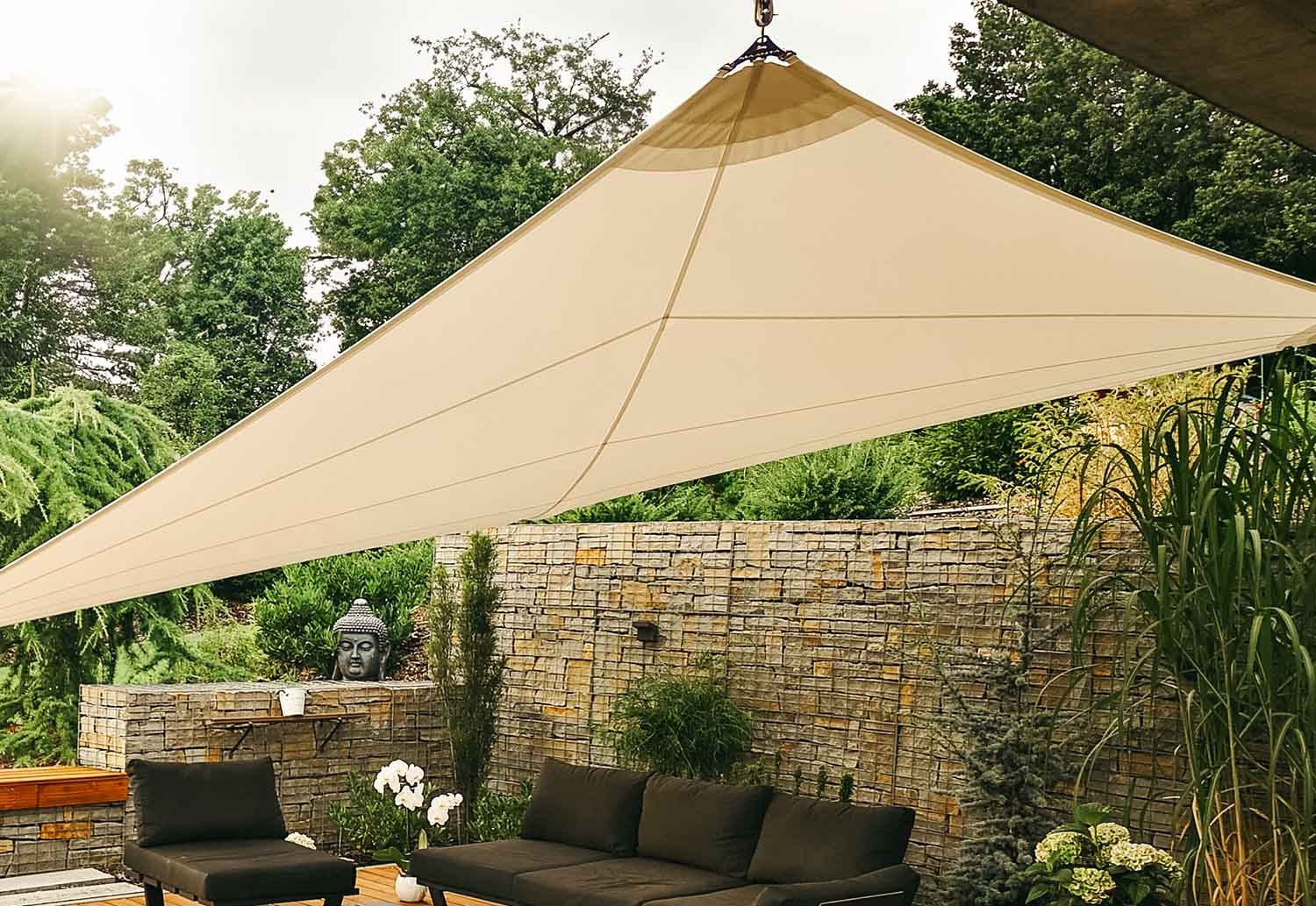
The Shade Sail: A Simple Idea That Changes Everything Outside
There’s a particular kind of summer afternoon that stays with you. The light is long and warm. The garden is doing what gardens do in July. And outside, under a panel of fabric that moves just slightly in the breeze, a family is still at the table long after dinner should have ended.
This is what a good shade sail does. Not just block the sun — but make a place worth staying in.
For a lot of American families, outdoor shade has meant one of two things: a pergola, which is a commitment — structurally, financially, and permanently — or a patio umbrella, which is an improvisation. Solid or wobbly, with nothing much in between. The shade sail sits in the space that neither of those fills: flexible enough to go up in a weekend, considered enough to feel like it was always meant to be there.
What a Shade Sail Actually Is

The idea is simple: a panel of tensioned fabric, anchored at three or four corners to posts or walls, stretched overhead to create a defined area of shade. What makes it different from an awning or a canopy is the tension. A properly installed shade sail is pulled taut between its anchor points, which gives it a clean, architectural quality that fabric left to hang never has.
The material matters more than most people realize. Quality shade sails are made from high-density polyethylene (HDPE) — a breathable, open weave that blocks up to 95% of UV rays while letting air move freely underneath. This is the detail that separates a sail that creates shade from one that creates an outdoor oven. The right fabric keeps the space cooler than direct sun while staying light enough that wind passes through rather than stressing the anchor points.
Stretched between anchor points, a sail creates what architects sometimes call a soft ceiling — a plane overhead that defines a space without enclosing it. The light that filters through has a particular quality: softer than direct sun, with just enough warmth and movement to remind you you’re outside. For a farmhouse patio or a back porch surrounded by garden, this kind of addition doesn’t compete with the space. It completes it.
When Someone Actually Gets It Right

Like most things made to live outdoors, shade sails vary enormously in quality. The difference shows quickly — in stitching that holds or doesn’t, in corner hardware that corrodes after a season, in fabric that stretches out of shape by August and never quite recovers. A sail that looked right in April can look defeated by September.
This is why it’s worth knowing that some manufacturers take the craft seriously. In Italy, where outdoor living has always been treated as an extension of the home rather than an afterthought, there’s a long tradition of making things for exterior spaces with the same care given to interiors. A terrace is not an afterthought. The fabric stretched overhead to create shade should be as carefully chosen as the fabric on a sofa.
That’s the standard that Maanta shade sails bring to the American market. The fabrics are dense and consistent, with a hand feel that signals quality before you’ve even installed them. The colors — warm stone, natural sand, soft linen, quiet gray — are chosen with the kind of restraint that makes things last visually as well as physically. The hardware is stainless and solid, built for years of tension rather than one season of it. Small things, all of them. And exactly the kind of small things that add up to something you love rather than something you tolerate.
A Weekend Project That Feels Like a Permanent Decision
Most people are surprised by how straightforward the installation is. Three or four anchor points — structural posts, a masonry wall, an existing beam — each fitted with a D-ring or eye bolt. The sail clips on, turnbuckles at two corners let you dial in the tension, and within an afternoon the space looks like it was designed that way from the start.
A few things make the difference between a sail that works and one that just exists. Size up: a shade sail should extend a foot or two beyond the seating area, or it won’t cover it when the sun is at an angle. Go high with the anchor points: the steeper the pitch, the better rain sheds rather than pooling in the center. And choose a neutral — a color that reads like part of the landscape rather than a feature added to it.
In winter, the sail comes down in twenty minutes and stores flat. In spring, it goes back up. After a few seasons, the rhythm of it becomes part of how you think about the year — one of those small domestic rituals, like bringing the garden furniture out of storage, that marks the arrival of summer better than the calendar does.
The Patio You’ve Been Walking Past
What families describe, once a shade sail is up, is less a home improvement and more a rediscovery. The table that gets used now, every evening. The corner of the yard the kids claimed for themselves. The porch that changed from a place you pass through to a place you stay.
It turns out the outdoor space was already there. It just needed a reason to be worth it.


