
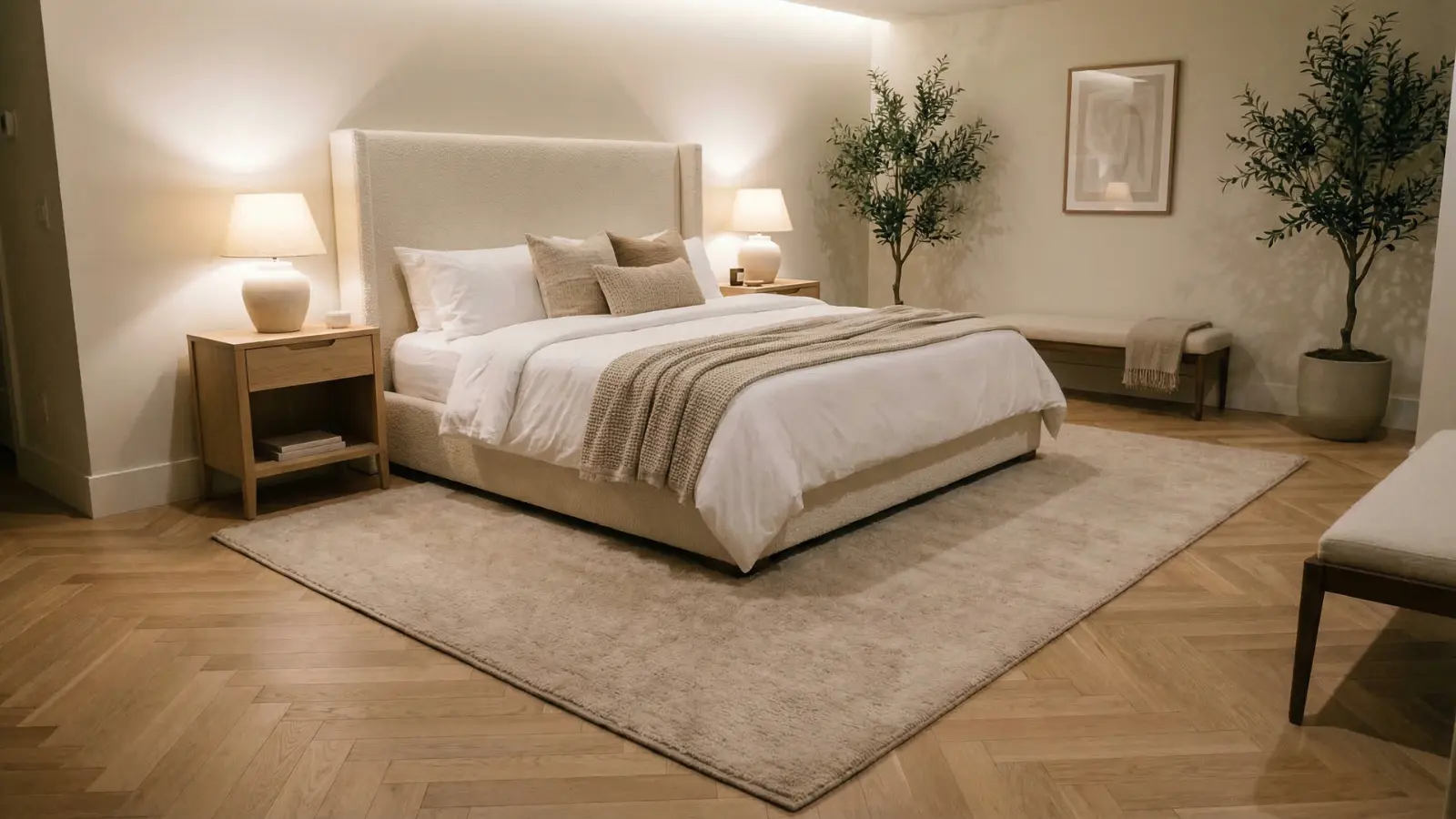
Rug Size for King Bed: How to Pick the Right One
Picking a rug for a king bed seems simple until you’re standing in a store holding a tape measure and second-guessing everything.
The bed is wide. The room has its own limits. And the wrong size can throw off the entire look of your bedroom.
I’ve seen rugs that barely peek out from under the bed and ones that crowd the whole room. Neither looks right.
In this blog, you’ll learn which rug sizes actually work with a king bed, how room size plays a role, and what to look for before you buy. By the end, you’ll know exactly what size to choose and why.
Standard Rug Sizes that Work with A King Bed
A king bed is 76 inches wide and 80 inches long. That’s a big footprint, and not every rug size can keep up with it.
Here are the sizes you’ll commonly see recommended for king beds:
- 8×10: The minimum size that can work. It’s a tight fit but manageable with the right placement.
- 9×12: The most recommended size for king beds. Works in most standard bedrooms.
- 10×14: Best for larger rooms where you want more coverage and visual weight.
- 12×15 or larger: Reserved for oversized or open-plan bedrooms.
These are the sizes worth considering. Anything smaller than 8×10 tends to get swallowed under the bed and loses its purpose entirely.
A rug needs to extend visibly beyond the sides and foot of the bed. If it doesn’t, it looks like an afterthought rather than a design choice.
The 76-inch width of a king bed leaves very little room for error. A rug that’s too narrow won’t show enough on either side, no matter how well you position it.
How Rug Size Relates to Bed Dimensions and Exposure
Size alone doesn’t tell the full story. What really matters is how much of the rug stays visible once the bed is on top of it. That visible strip is called exposure, and it’s what makes or breaks the look.
The 18–24 Inch Rule
The general standard is to have 18 to 24 inches of rug showing on each side and at the foot of the bed. This exposure creates visual balance. It frames the bed instead of hiding under it.
Here’s what happens when exposure is off:
- Too little exposure: The rug barely peeks out. It looks like it doesn’t belong there.
- Too much exposure: The bed looks undersized compared to the rug beneath it.
- Uneven exposure: One side shows more than the other. This usually happens when the rug isn’t centered properly.
Why This Affects Your Size Choice
A king bed is 76 inches wide. Add 18 inches on each side, and you’re already at 112 inches, or just over 9 feet.
That’s why a 9×12 ft rug is the go-to recommendation. It hits that exposure target on the sides and still extends properly at the foot.
An 8×10 rug is only 96 inches wide. That leaves roughly 10 inches per side, less than the ideal range, but workable in smaller rooms with partial placement.
Get the exposure right, and the rest of the sizing decisions become much easier.
8×10 vs. 9×12 vs. 10×14: Which One Should You Choose?
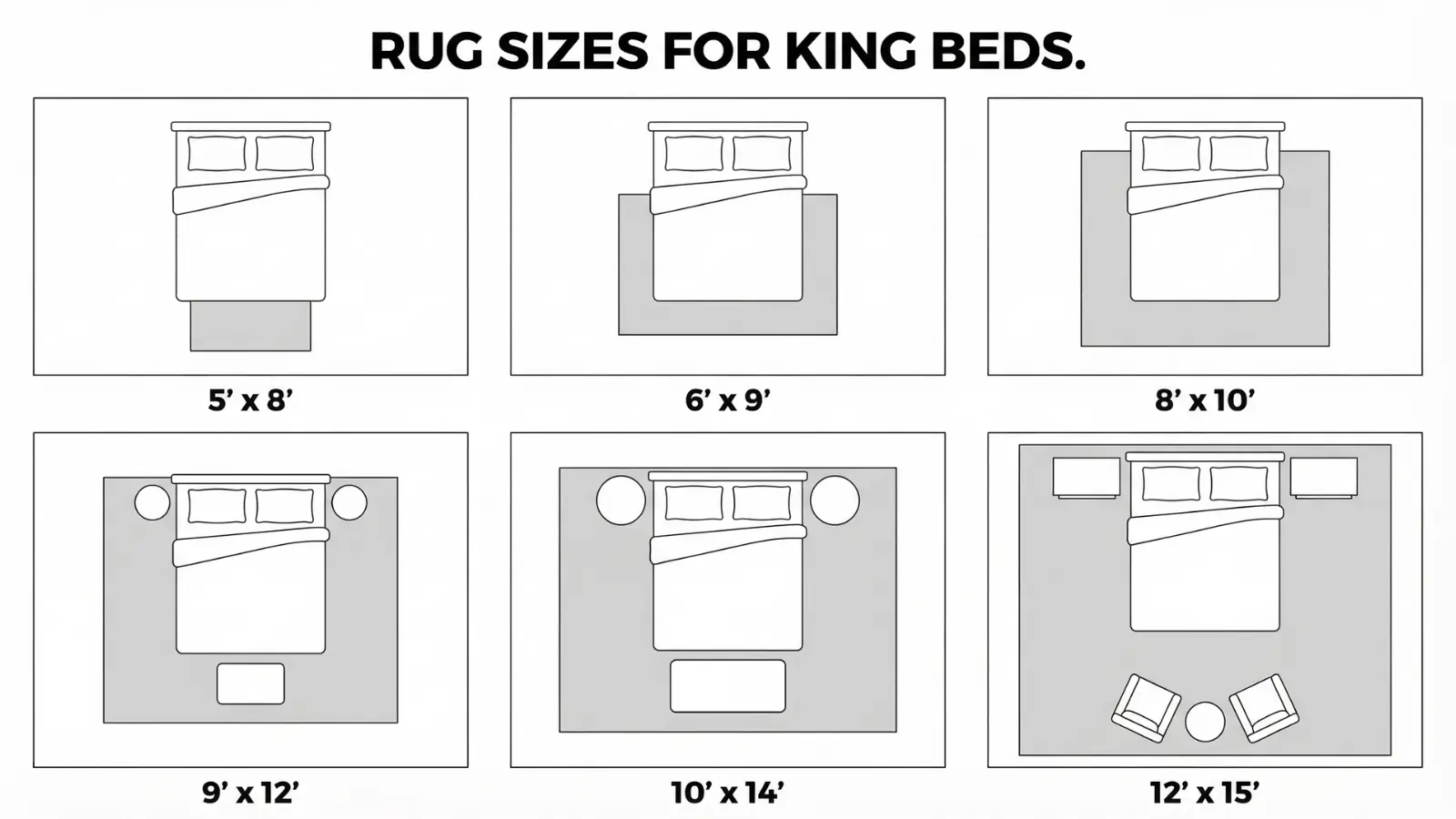
Choosing the right rug size depends on your room size, layout, and how much coverage you want around the bed.
| Rug Size | Works When | Fails When | Key Note |
|---|---|---|---|
| 8×10 | Smaller rooms, placed under bottom 2/3 of bed, no nightstand coverage needed | Need full bed and nightstand coverage, room is large | Narrow width (96″) leaves ~10″ side exposure, which can feel tight |
| 9×12 | Standard bedrooms, covers bed well, reaches near or under nightstands | Rarely fails except in very small or very large rooms | Close to ideal ~18″ exposure, making it the safest choice |
| 10×14+ | Large bedrooms, extra furniture like benches or chairs, full layered look | Small rooms feel crowded or cluttered | Best for spacious layouts and a full-coverage, hotel-style look |
This format helps you quickly scan and compare each option before choosing the right size.
Choosing Rug Size Based on Room Size and Layout
Your bed size is just one part of the equation. The room itself plays an equally important role in deciding which rug works best.
A rug that fits the bed perfectly can still look wrong if it doesn’t relate to the room around it.
The key rule: Leave at least 18 inches of bare floor between the rug edge and the wall. Any less and the room starts to feel cramped.
Here’s how room size maps to rug size:
- Small bedroom (under 10×10 ft): An 8×10 with partial placement is your best option. A larger rug will crowd the space.
- Medium bedroom (10×12 to 12×14 ft): A 9×12 hits the right balance. It fills the space without pushing against the walls.
- Large bedroom (12×14 ft and above): A 10×14 or larger works here. It fills the visual space properly and anchors the bed.
Two placement failures to watch for:
- Rug touching the walls: This makes the room feel boxed in and smaller than it is.
- Rug floating too far from the bed: When there’s too much bare floor between the bed and the rug edge, the two elements look disconnected.
Both come down to choosing a size that fits the room, not just the bed. Measure your room before you buy. Mark out the rug dimensions with tape on the floor if you can. It takes five minutes and saves a costly return.
Full Coverage vs. Partial Placement: What Changes Your Choice
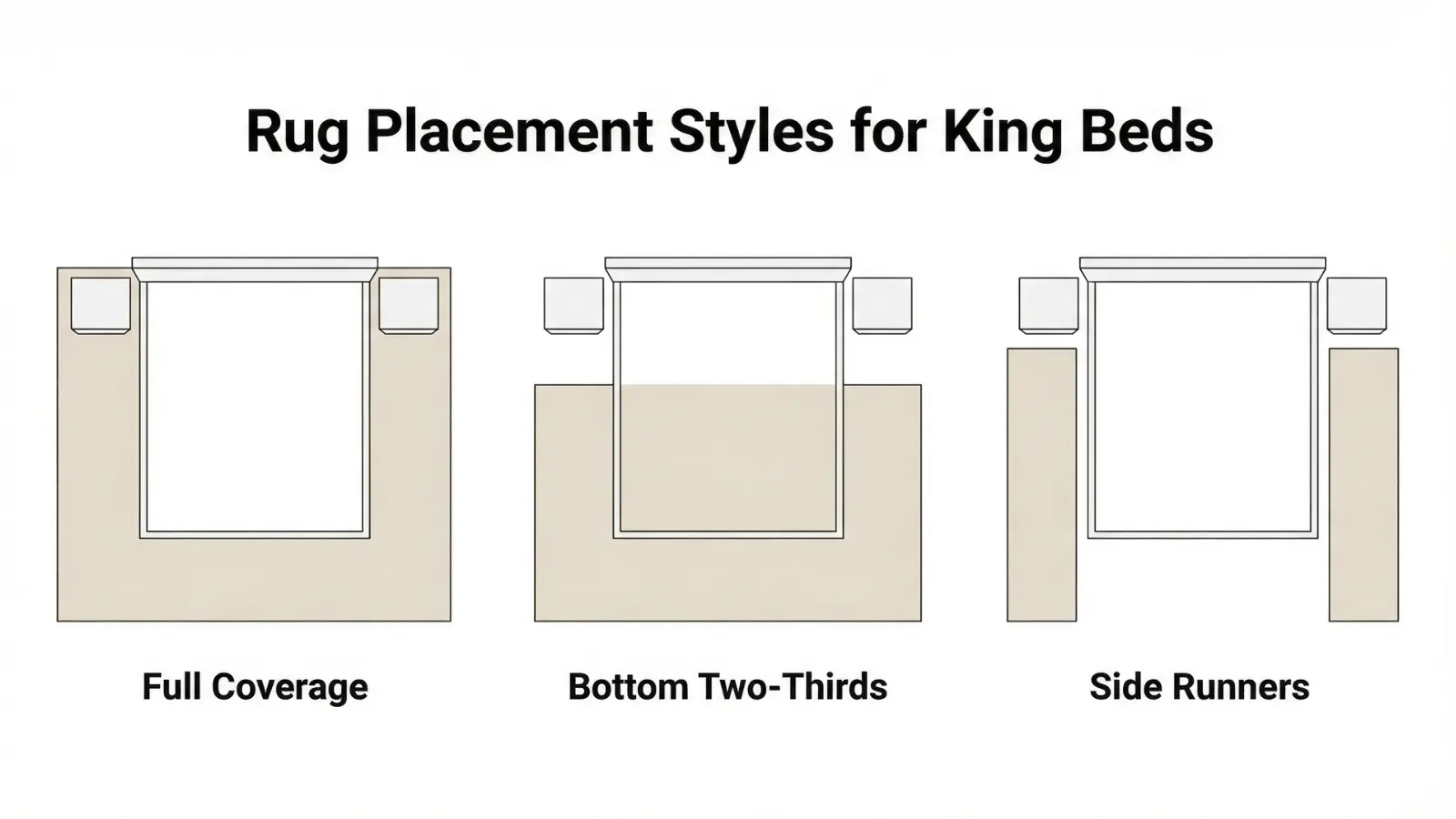
How you place the rug under your king bed is just as important as the size you pick. Different placement styles call for different sizes. Here’s a breakdown of the three main approaches:
1. Full Coverage Under Bed and Nightstands
This style places the rug fully under the bed and extends it to sit beneath both nightstands as well.
It creates a unified visual block. The bed, nightstands, and rug all read as one anchored zone.
To pull this off, you need a minimum of a 9×12 rug. In many cases, a 10×14 rug does the job better, especially if your nightstands sit wide of the bed.
This is the cleanest look but also the most demanding in terms of rug size.
2. Bottom Two-Thirds Placement
Here, the rug slides out from under the headboard end and sits under the lower two-thirds of the bed. The headboard end of the bed rests on the bare floor.
The rug is shown at the sides and foot of the bed. This works well with an 8×10 or a 9×12 rug.
It’s a practical choice for smaller rooms where full coverage isn’t possible. The look is slightly less polished than full coverage but still balanced when done right.
3. Side Runners or Split Rugs
Instead of one large rug, this approach uses two narrow runners placed on either side of the bed. It targets comfort at the foot-entry points rather than visual framing.
You step onto something soft when you get out of bed, but the overall look is less cohesive. This works as a budget-friendly alternative or when the room layout makes a large rug impractical.
The trade-off is clear, though. Runners won’t give you the grounded, anchored feel that a properly sized area rug does.
Common Mistakes that Lead to The Wrong Rug Size
- Choosing size based only on the bed: The room size matters just as much. A rug that fits the bed perfectly can still overwhelm or underwhelm the space.
- Going smaller than 8×10: Anything under this size gets lost under a king bed. It won’t show enough on the sides to look intentional.
- Not accounting for nightstands: If you want full coverage, your nightstands need to factor into the size calculation. Ignoring them leads to a rug that falls short.
- Skipping the clearance check: Forgetting to leave 18 inches between the rug edge and the wall is one of the most common oversights. It makes the room feel tight.
- Assuming bigger is always better: A 10×14 in a small room creates visual clutter. Bigger only works when the room can support it.
Most of these mistakes happen because people skip the measuring step. Before buying, mark out your intended rug size on the floor with painter’s tape. It gives you a real sense of scale before you commit.
Quick Decision Table to Pick the Right Rug Size
Use this quick table to match your room setup and style preference with the right rug size:
| Your Situation | Recommended Size | Placement Style |
|---|---|---|
| Small room (under 10×10 ft) | 8×10 | Bottom two-thirds |
| Standard room (10×12 to 12×14 ft) | 9×12 | Full or partial |
| Large room (12×14 ft and above) | 10×14 or larger | Full coverage |
| Want full coverage with nightstands | 9×12 minimum, 10×14 ideal | Full coverage |
| Prefer a minimal look | 8×10 | Bottom two-thirds |
| Tight budget or awkward layout | Side runners | Sides only |
| Any size, any room | Confirm 18–24″ exposure on sides and foot | — |
| Any size, any room | Confirm 18″ bare floor to wall | — |
When in doubt, go one size up. It’s easier to work with a slightly larger rug than one that’s too small to frame the bed properly.
Conclusion
Choosing the right rug size for a king bed isn’t complicated once you know what to look for. Match the size to your room, not just your bed.
Get the exposure right. And always measure before you buy. Those three steps will get you to the right answer faster than anything else.
Use the checklist above to finalize your pick and tape it out on the floor before you commit. A little prep goes a long way.
The right rug doesn’t just sit under your bed; it ties the whole room together. Still unsure about your room size or placement style? Drop a comment below, and I’ll help you figure it out.
Frequently Asked Questions
How Far Should a Rug Extend Past a King Bed?
A rug should extend 18 to 24 inches beyond the sides and foot of the bed. This keeps the look balanced and ensures the rug is visible from all angles.
Should a Rug Be Centered Under a King Bed?
Yes, always center the rug under the bed. Uneven placement throws off the visual balance and makes the room feel asymmetrical.
Can a Rug Be Too Big for A Bedroom?
It can. If the rug edges come within 18 inches of the walls, the room starts to feel cramped. Always leave enough bare floor around the rug edges.
What Shape Rug is Best for A King Bed?
A rectangle is the most practical shape for a king bed. It naturally aligns with the bed frame and room layout. Round rugs can work as an accent at the foot of the bed, but they won’t provide full coverage.


