Challenges of Moving: Newton’s Turnpike Impact on Local Logistics
Newton’s Mass Pike Problem: Why Two Villages Ten Minutes Apart Can Be a 25-Minute Truck Ride
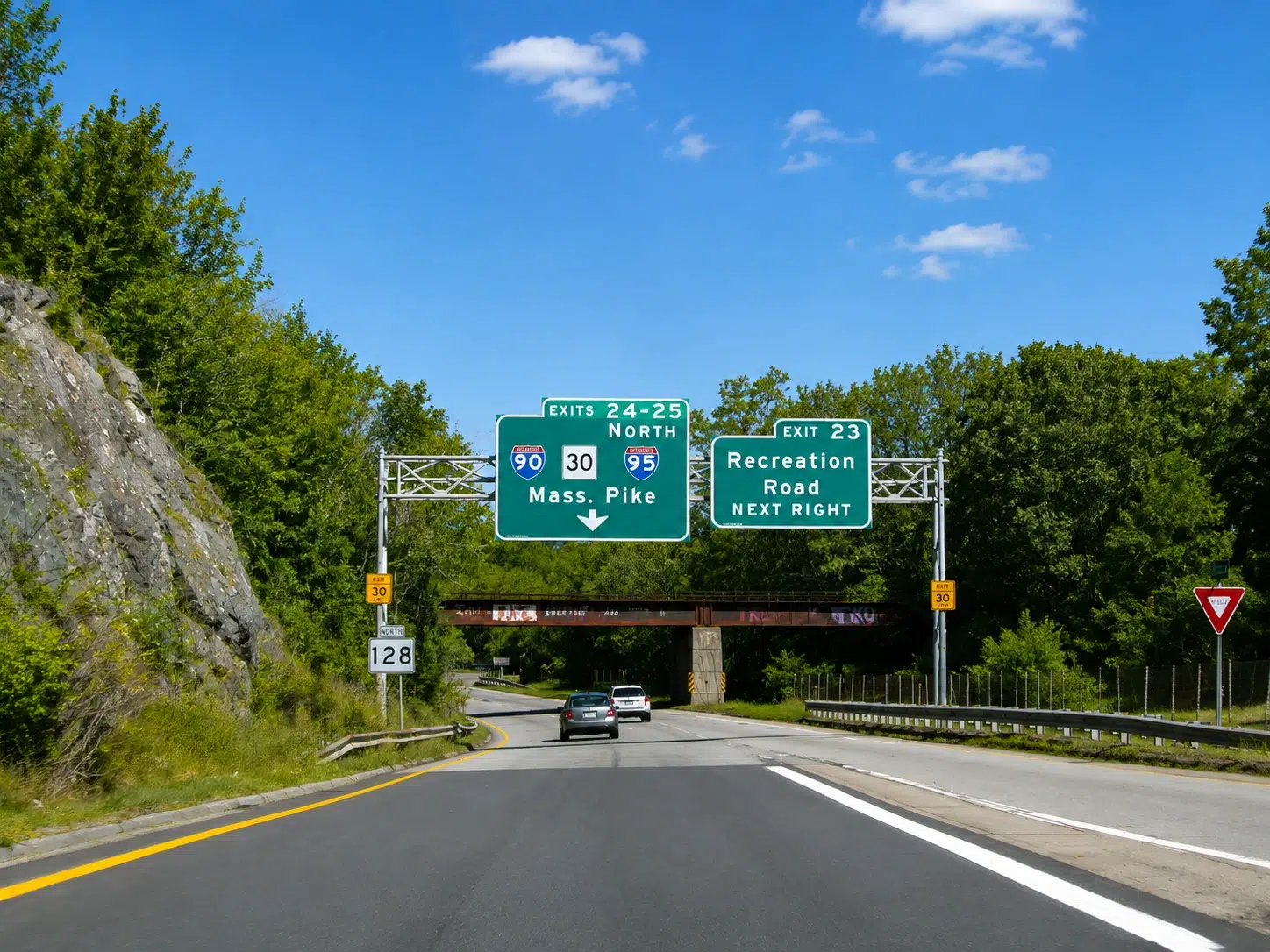
Pull up a map of Newton and it looks simple enough – thirteen villages, close together, all technically the same city. Pull up the actual roads and you find out the Mass Pike runs straight through the middle of it, and suddenly two addresses that look like a five-minute drive apart turn into a genuine routing problem. We’ve had crews budget fifteen minutes to get from one Newton village to the next, only to watch the GPS reroute them onto I-90 because the direct road simply doesn’t connect the way the map suggests it should.
This isn’t a Newton-specific inconvenience so much as it’s the defining fact of how the city is built. Newton isn’t one town with one layout – it’s thirteen villages that grew up independently around old rail stops and crossroads, and then, decades later, a interstate highway got dropped straight through the middle of several of them. The villages didn’t move. The highway just arrived and started dictating how you get between them.
Newton Corner Is Literally Cut in Half
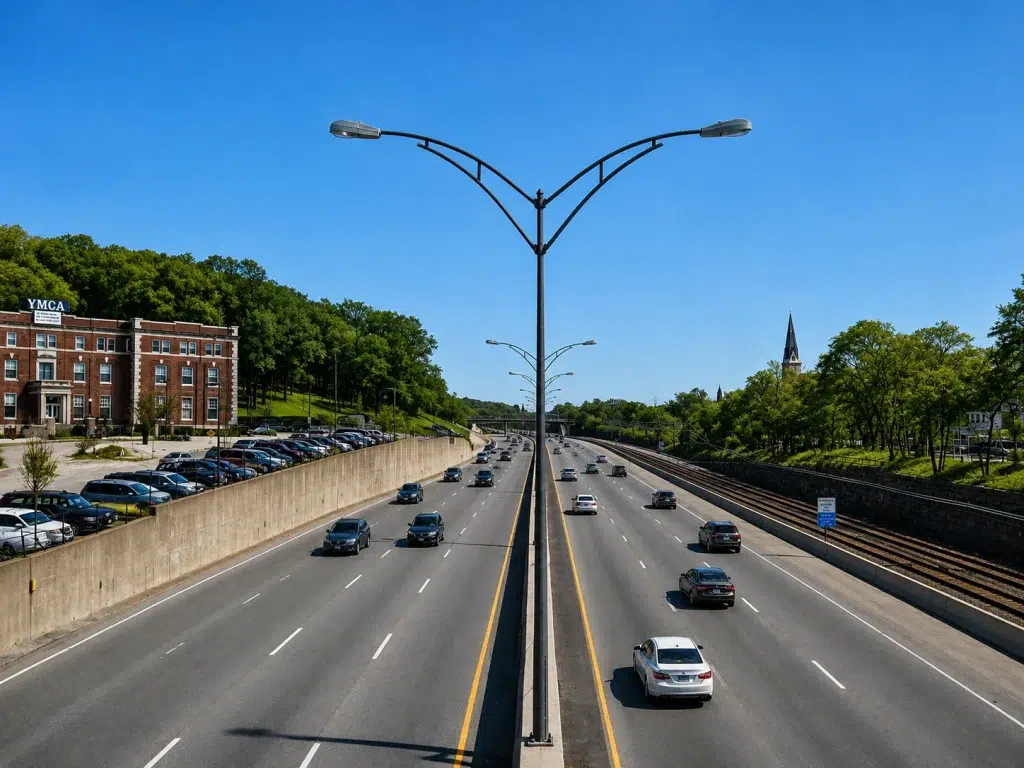
The clearest example is Newton Corner, and it’s not subtle. The Mass Pike runs directly through the village, and the main way across it is a large, notoriously complicated rotary at Exit 127 that locals have nicknamed the “Circle of Death” – not exactly a name that inspires confidence in a moving crew navigating it for the first time with a fully loaded truck. Where Newton Corner used to be one continuous village built around a 17th-century crossroads, it’s now a village split by a limited-access highway, with traffic funneled through one complicated interchange to get from one side to the other.
For a mover, that’s not trivia, it’s a real planning problem. A house on one side of that rotary and a house on the other side aren’t a quick local hop – they’re two separate approaches, and the route between them runs through one of the more infamous traffic interchanges in the Boston area. Get the timing wrong and a short local move turns into a genuine slog through rotary traffic, twice, once each way.
The Pike Doesn’t Care About Village Lines
Newton Corner is the most obvious case, but it’s not the only place this shows up. The Pike threads through multiple villages on its way across the city, and because it’s a limited-access highway, you can’t just cross it wherever you happen to be standing. You have to get to one of the interchanges, which means the actual driving distance between two villages often has almost nothing to do with how close they look on a map.
Two houses that are a few blocks apart as the crow flies can require a full loop out to an on-ramp, a stretch of highway driving, and a loop back in – all because the direct local road either doesn’t cross the Pike at all or dead-ends into it.This matters more for moving trucks than it does for a regular commute, because a truck already takes longer to load, longer to navigate tight village streets, and longer to unload – adding an unplanned highway detour on top of that isn’t a minor inconvenience, it’s real time on an hourly job. And Newton’s ongoing highway construction, including bridge work near the Newton/Weston line, means some of these routes aren’t even fixed – they shift depending on what’s closed that particular week.
Why “It’s All Newton” Isn’t Good Enough Information
Here’s where people get tripped up: when you’re planning a move and you tell your mover “it’s a Newton to Newton move,” that phrase is doing almost none of the work it sounds like it’s doing. Newton Centre to Waban is a very different trip than Newton Corner to Nonantum, even though both pairs are, technically, “within Newton.” Whether the Pike sits between your old address and your new one changes the entire routing plan, and it’s not something you can eyeball from a village name alone.
A crew that knows Newton will ask the follow-up question before quoting the job: which side of the Pike is each address on, and which interchange connects them. A crew that doesn’t know the city will plug both addresses into a GPS, get an estimated drive time that assumes normal traffic on a normal day, and then find out the hard way when the actual route runs through a rotary with a nickname like “the Circle of Death” during the exact wrong hour of a weekday.
What This Actually Costs You If It’s Missed
None of this is abstract once it hits a bill. A truck that gets rerouted onto the Pike unexpectedly is burning fuel and labor hours it wasn’t quoted for. A crew that hits the Newton Corner rotary during a bad traffic window loses time that has to come from somewhere – usually the schedule for the rest of the day, which is exactly how a moving company ends up running late to every job after yours. And a move planned without accounting for ongoing highway construction near the Newton/Weston border can run into last-minute detours that a crew with local, current knowledge would have already planned around.
The fix isn’t complicated, but it does require actually knowing the city rather than just knowing the address. A local mover should be able to tell you, before moving day, roughly how the truck is getting from point A to point B – not just the estimated drive time a map gives you, but which interchange it’s using and whether that interchange has a reputation for backing up at a particular time of day.
What to Ask Before You Book
If you’re moving within Newton, or into a Newton village from somewhere else, it’s worth asking your moving company directly whether the Mass Pike sits between your old and new address, and if so, which interchange they’re planning to use to get between them. It’s a more useful question than “how long will it take,” because the honest answer to that question depends entirely on the answer to this one.
It’s also worth asking whether they’re tracking any current highway construction on the route, since Newton’s Pike-adjacent infrastructure has had ongoing bridge and interchange work in recent years that can change a route with little notice. A crew that’s moved households through Newton recently will know about this. A crew that hasn’t will find out the same way you would – by getting stuck in it.
A Few Questions We Get Asked About Newton Moves
Is the Mass Pike really that big a deal for a local move?
It can be, yes – more than people expect. If your old and new address sit on opposite sides of the Pike within Newton, the actual driving route between them depends on which interchange connects the two, not just the straight-line distance. That can turn a move that looks short on a map into a longer, slower trip in practice.
What’s the “Circle of Death” and why does it matter for my move?
It’s the local nickname for the large, complicated rotary in Newton Corner where the Mass Pike splits the village and traffic gets funneled through one interchange to cross it. If your move involves getting from one side of Newton Corner to the other, there’s a good chance your truck is going through it.
Does it matter which two Newton villages I’m moving between?
Yes, more than it should, honestly. Some village pairs have a direct local road connecting them; others are separated by the Pike and require a highway loop to get between. “Newton to Newton” doesn’t tell a mover much on its own – the specific villages, and whether the highway sits between them, do.
Should I ask my moving company about highway construction before booking?
It’s a reasonable question, especially in Newton. The Pike has had ongoing bridge and interchange work near the city in recent years, and a route that worked fine last month can shift with little warning. A mover with recent, local experience will usually already know what’s currently affecting traffic in the area.