
Designing to the IAQ Procedure: A Practical Workflow for ASHRAE 62.1
Most ventilation design in commercial buildings still runs through the Ventilation Rate Procedure. It is prescriptive, familiar, and easy to defend in plan review. It is also expensive. Conditioning outdoor air is one of the largest recurring energy loads in a commercial HVAC system, and the VRP requires engineers to bring in fixed volumes of it regardless of what is actually happening inside the space.
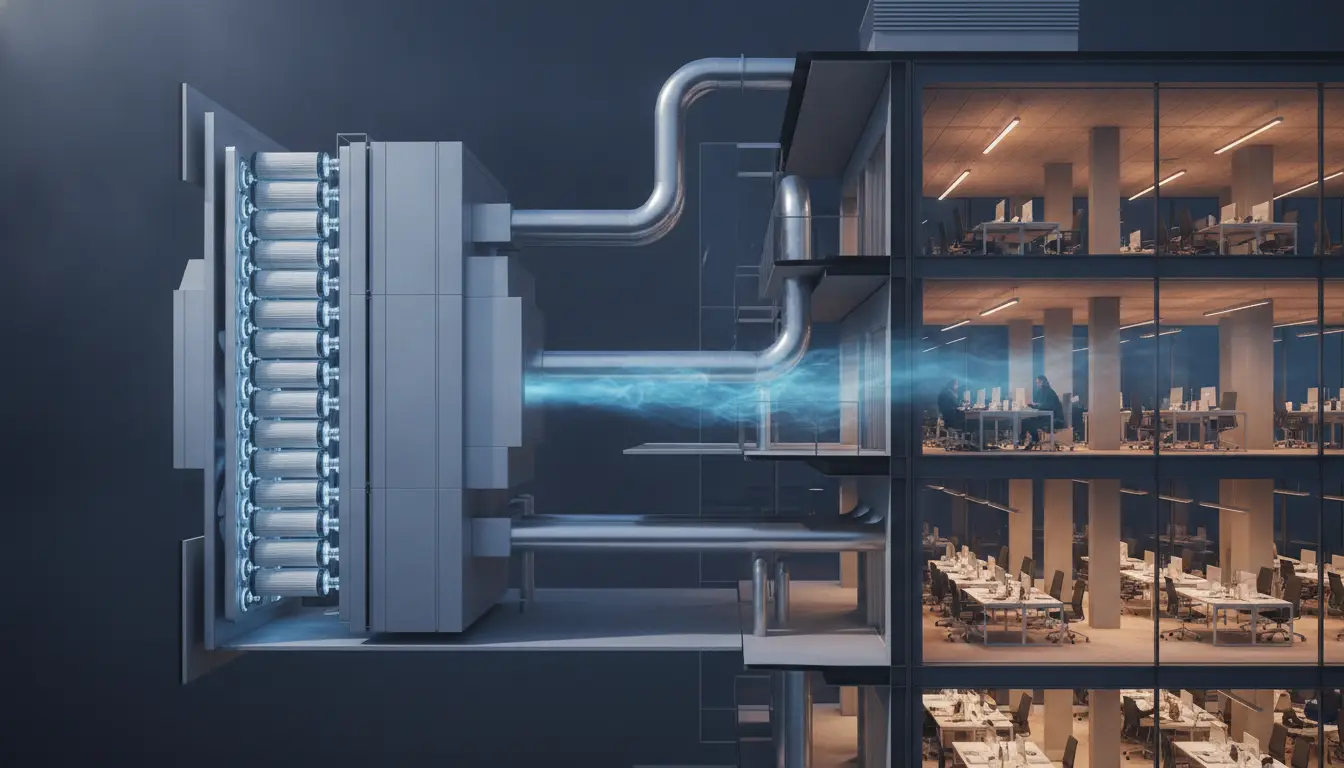
ASHRAE 62.1-2022 offers a second compliance path that more design teams are starting to specify: the Indoor Air Quality Procedure, or IAQP. Instead of prescribing airflow rates by occupancy and floor area, the IAQP is a performance-based method. The engineer identifies contaminants of concern, sets concentration limits, accounts for sources, and then demonstrates through mass-balance calculations that the design holds indoor concentrations below those limits. Air cleaning systems can offset a portion of the outdoor air that the VRP would otherwise require.
The payoff is real. Reducing outdoor air intake shrinks heating and cooling loads, which can mean smaller equipment at design time and lower energy bills for the life of the building. The catch is that the IAQP asks more of the engineer up front. This article walks through what that work actually looks like and where calculation tools fit into the process.
What the IAQP requires of the design team
The 2022 revision of Standard 62.1 tightened the IAQP considerably. It now specifies design compounds and PM2.5 as required contaminants of concern, sets concentration limits for them, and requires documentation of the mass-balance analysis. That removed much of the ambiguity that made earlier versions of the procedure hard to apply consistently, and it gave code officials a clearer basis for accepting IAQP designs.
In practice, an IAQP design involves four pieces of work. First, zone characterization: occupancy, floor area, space type, and the resulting contaminant generation rates. Second, source accounting: what the building materials, occupants, and activities contribute. Third, air cleaning credit: the removal efficiency of whatever filtration and air cleaning equipment serves the zone, applied to each contaminant. Fourth, the mass-balance calculation itself, run per contaminant per zone, demonstrating that steady-state concentrations stay below the design limits.
None of this is conceptually difficult for a mechanical engineer. The friction is volume. A mid-sized office building might have dozens of zones, each needing the calculation run across the full set of design compounds. Done in spreadsheets, this is slow, error-prone, and painful to revise when the architect moves a wall.
Where calculation tools fit
This is the problem purpose-built IAQP tools are designed to solve. GPS Air, one of the manufacturers active in the air cleaning space, publishes a free IAQP design calculator built on the ASHRAE 62.1 mass-balance method. The tool, called the smartIAQ® Project Builder, lets an engineer define zones with their parameters and contaminant sources, apply air cleaning systems, and generate project-level outputs suitable for drawings and specifications. Other vendors offer similar tools, and several firms maintain their own internal models. The common thread is that the zone-by-zone math gets automated, and revisions become a parameter change rather than a rebuild.
Whichever tool a firm uses, the engineer still owns the inputs and the judgment. Contaminant source assumptions need to reflect the actual program of the building. Air cleaning performance claims need third-party test data behind them, not just manufacturer literature. And the documentation package needs to be complete enough that the authority having jurisdiction can follow the analysis.
Questions to resolve before committing to the IAQP
The IAQP is not the right call on every project. A few questions help sort out where it earns its keep.
Has the local code authority accepted IAQP designs before?
Adoption varies by jurisdiction, and a first IAQP submission in a given plan review office will take longer. Bringing complete mass-balance documentation shortens that conversation considerably.
Does the energy savings justify the added engineering effort?
The economics favor buildings in climates with high heating or cooling loads, buildings with high occupant density, and projects where reduced outdoor air translates into smaller rooftop units or air handlers. A quick feasibility estimate early in schematic design tells you whether the full analysis is worth running.
Is the air cleaning equipment verifiable?
The procedure’s credibility rests on removal efficiency data. Specify equipment with published third-party testing for the specific contaminants in your analysis, and require ozone emissions data as part of the submittal. UL 2998 validation for zero ozone emissions has become a standard checkpoint for ionization-based equipment in IAQP designs.
The direction of travel
The IAQP has been in Standard 62.1 for decades, but the 2022 revision and the post-pandemic attention on ventilation have pushed it from a niche path into a mainstream design option. Decarbonization targets are doing the rest: when a building owner is being asked to cut energy use and a third or more of HVAC load is tied to conditioning outdoor air, a code-recognized method for safely reducing that intake gets a hearing.
For engineers, the practical takeaway is that the IAQP is now well-defined enough to specify with confidence, and the calculation burden that once made it impractical has largely been absorbed by software. The remaining work is the part that was always going to belong to the engineer: sound assumptions, verifiable equipment, and documentation that holds up in plan review.


