Navigating the Orlando Housing Market: A Guide for First-Time Buyers
Orlando’s housing market is fueled by a robust tourism and hospitality industry, a rapidly expanding technology sector, and a steady influx of residents relocating from the Northeast and Midwest. For first-time buyers, navigating this landscape can feel daunting. But as the 2026 real estate market continues to stabilize, the path to homeownership in Central Florida has become clearer than it has been in years. By understanding the financial realities of renting versus owning — and the practical advantages of new construction — first-time buyers can secure a strong foothold in one of the state’s most active metropolitan areas.
Breaking the Rent Cycle in Central Florida
The financial argument for buying a home in Orlando is increasingly grounded in real numbers. Nationally, the median asking rent for units with up to two bedrooms is roughly $1,650, with some online publications showing prices above $1,800. Despite differences in median asking prices, most experts agree rent prices are increasing. In Orlando, renters face similar pressures, and every rental payment made is a contribution to a landlord’s equity — not their own.
What makes Orlando genuinely compelling right now is how close buyers are to monthly cost parity with renters. According to HudUser.gov, some rent prices in Orlando are equal to or higher than advertised monthly payments from homebuilders with starter homes. Overall, the gap is narrowing, and when equity accumulation enters the equation, the long‑term case for buying instead of renting can be compelling for many households, especially those planning to stay in the area.
Transitioning to homeownership fundamentally changes the financial picture. A fixed-rate mortgage on a new construction home locks in the bulk of a buyer’s monthly housing cost, insulating them against rent increases and inflationary pressure on the rental market. Every mortgage payment builds equity. As Orlando’s population continues to grow — Florida is projected to reach nearly 26 million residents by 2035 — the long-term appreciation of real estate in Central Florida represents a meaningful wealth-building opportunity for buyers who enter the market now.
Population and housing trends documented by the Florida Housing Data Clearinghouse show continued in-migration to Central Florida, which reinforces the long-term case for owning in metros like Orlando as demand for housing steadily grows.
Understanding the Orlando Price Environment
Home prices in the Orlando area have stabilized after years of rapid appreciation. According to the Federal Reserve Bank of St. Louis, the median listing price of homes in the Orlando-Kissimee-Sanford area were $419,000 as of April 2026; $6,000 less than the median home prices one-year ago. While Stacker’s March 2026 figures report a median sale price of $400,000, flat on an annual basis. Local brokerage Fannie Hillman characterizes the market as holding in the high $300,000s. The takeaway from all three sources is the same: the market is stabilizing, conditions are more balanced than they were during the peak of the seller’s market, and buyers have more room to make thoughtful decisions.
This is not a market in freefall — it is a market finding its footing, which historically is one of the better moments to buy.
The Simplified Buying Process
For many first-time buyers, the traditional homebuying process is a source of real stress. The resale market often involves bidding wars, complex negotiations over deferred maintenance, and the uncertainty of older homes that may require immediate, expensive repairs — a new roof, a failing HVAC, outdated electrical. The custom build route introduces its own complications, typically requiring 10 to 16 months from contract to close, with 7 to 12 months of active construction, during which material costs and interest rates can shift, according to AmeriSave’s April 2026 analysis.
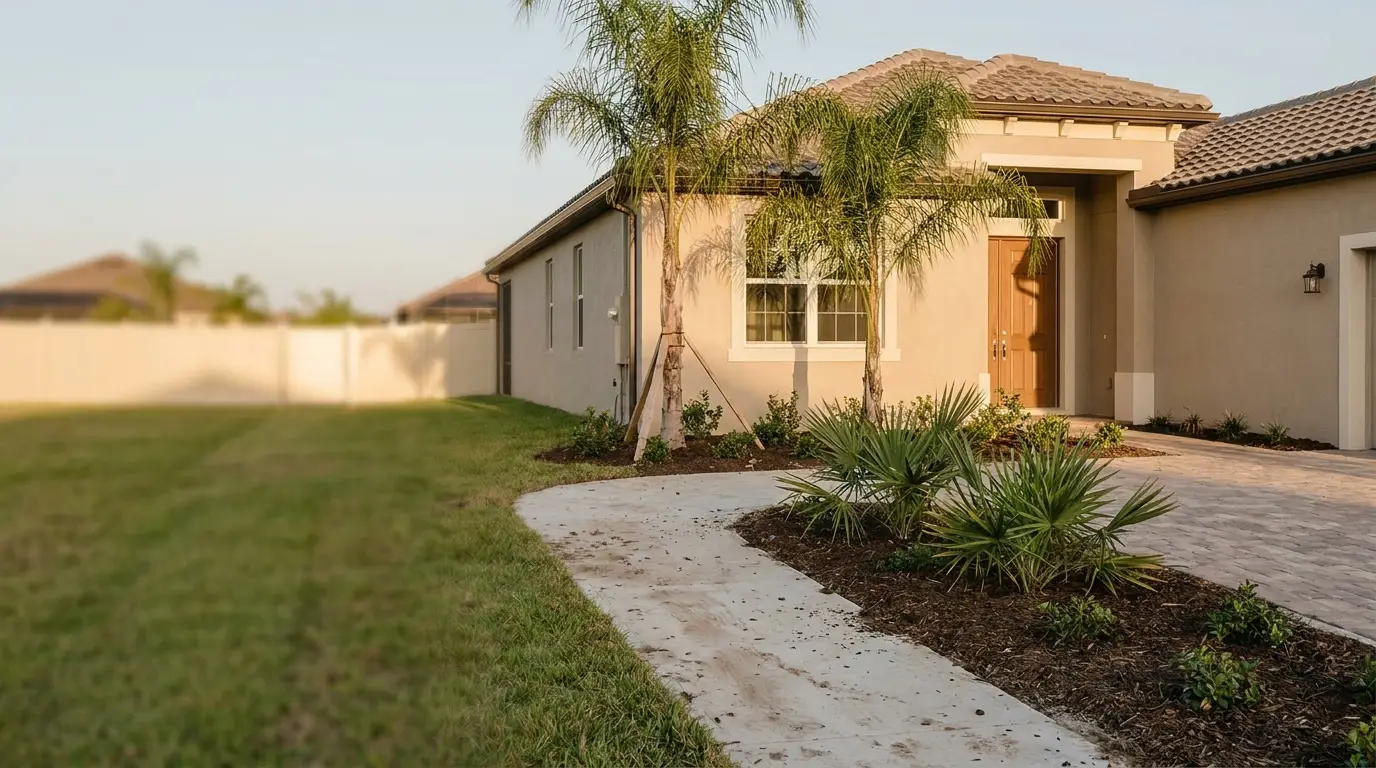
Move-in-ready new construction removes most of these friction points. Buyers can tour fully completed properties, verify that the floor plan and natural light work for them, and close and move-in on a predictable timeline. The price is locked in. There are no surprises waiting behind a wall or under a foundation. For a first-time buyer coordinating the end of a lease with the start of a mortgage, that predictability is not a minor convenience — it’s the difference between a smooth transition and a stressful one.
For first-time buyers who want a smoother transition from renting to owning, move-in-ready homes in Orlando new home communities offer more value, less construction, more predictable timelines, better promotions, and up-to-date building standards that reduce the risk of surprise repairs in the first years of ownership.
What Included Upgrades Mean for Orlando Buyers
One of the most significant traps for first-time buyers is what industry insiders call the “design center trap.” Many builders advertise a low base price, then layer on thousands of dollars in upgrades buyers need to make the home livable. For someone already stretching to cover a down payment, those unexpected costs can derail the purchase entirely.
The smarter financial move is to select a builder that includes a comprehensive package of premium upgrades as standard. When a home comes equipped with a fully appointed kitchen — granite countertops, wood cabinetry, a complete suite of stainless steel appliances — buyers sidestep the upgrade negotiation entirely and know what they’re spending from day one.
Beyond aesthetics, energy efficiency is not optional in Central Florida — it’s a financial necessity. Orlando’s long, hot, humid summers mean that double-pane Low-E windows, programmable thermostats, and high-efficiency HVAC systems directly affect what a buyer pays each month to keep their home comfortable. New construction built to Florida’s stringent modern building codes offers real advantages here, both in utility costs and in insurance pricing compared to older resale homes. Integrated smart-home technology — Wi-Fi-enabled systems that give homeowners control over energy use — fits the practical needs of Orlando’s growing base of young professionals and first-time buyers. When these features are bundled into the purchase price rather than tacked on as upgrades, they make the home financially sustainable from the moment of closing.
Frequently Asked Questions
Is Orlando a good market for first-time homebuyers in 2026?
Yes. Orlando’s market is stabilizing, with more inventory and less intense competition than in previous years. The region’s strong job growth across technology and tourism makes it a sound place to build long-term equity, and the buy-vs-rent gap is among the narrowest of any major metro in the country.
What are the benefits of move-in-ready homes for first-time buyers?
Move-in-ready homes are fully completed, eliminating the stress of construction delays, budget overruns, and bidding wars on older resale homes. Buyers can see exactly what they are purchasing and close on a predictable timeline.
Why is energy efficiency so important in Central Florida?
Orlando experiences long, hot, and humid summers. New construction homes built to modern Florida energy codes — with high-efficiency HVAC systems and Low-E windows — meaningfully reduce monthly cooling costs and can also reduce homeowners insurance premiums compared to older resale inventory.
How can first-time buyers avoid unexpected costs when building a home?
Look for builders that include premium upgrades — granite countertops, stainless steel appliances, smart-home technology — in the base price of the home. This avoids the “design center trap” and gives buyers a clear, reliable picture of their total cost before signing.